
Barite (BaSO₄) is an important non-metallic mineral widely used in oil and gas drilling fluids, chemical manufacturing, coatings, rubber, plastics, radiation shielding materials, and specialty fillers. Many of these applications require barite powder with tightly controlled particle size distribution (PSD), high whiteness, stable density, and minimal impurities. Ball milling remains one of the most commonly used grinding technologies for barite due to its robustness, scalability, and relatively low operating cost. However, a persistent challenge in industrial barite grinding is over-grinding—the excessive generation of ultrafine particles beyond the target size range. Over-grinding leads to:
- Energy waste
- Reduced product yield
- Unstable PSD
- Poor flowability
- Increased agglomeration
- Degraded downstream performance
Understanding why barite is particularly prone to over-grinding and how to precisely control its PSD is critical for achieving consistent product quality and maximizing economic efficiency.
This article explores the mechanisms behind barite over-grinding, examines key technical questions, and presents practical solutions and step-by-step strategies for precise PSD control.
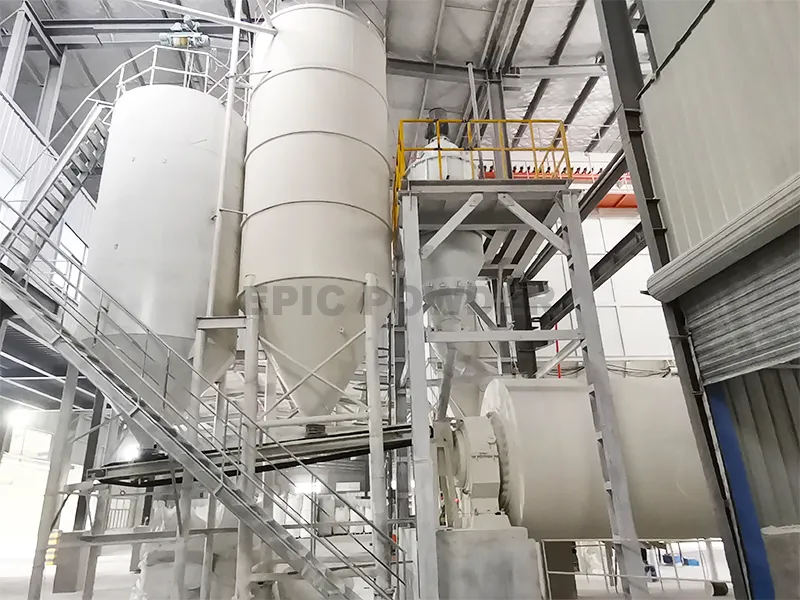
1. Conceptual Breakdown: Understanding Barite and Over-grinding
The Mineralogy of Barite
To understand why barite is difficult to grind “just right,” we must first look at its physical blueprint. Barite is relatively soft, with a Mohs hardness of 3.0 to 3.5. In the world of mineral processing, this is considered a “soft-brittle” material. While its low hardness suggests it should be easy to pulverize, its high density (4.3-4.7g/cm) creates high inertial forces during the tumbling action of a ball mill.
Defining Over-grinding
Over-grinding occurs when the comminution process continues beyond the liberation size or the functional requirement of the application. In a ball mill, this manifests as an excessive accumulation of “super-fines”—particles significantly smaller than the target D50 or D97 values.
For barite, over-grinding is not merely a waste of energy; it is a quality killer. In drilling fluids, too many fines increase the plastic viscosity of the mud without contributing to the necessary density. In paint applications, excessive fines dramatically increase oil absorption, leading to higher resin consumption and poor coating rheology.
The Mechanical Mechanism
In a tumbling ball mill, grinding occurs through two primary forces:
- Impact: The falling media strikes the material, causing rapid fracture.
- Attrition/Abrasion: The sliding and rolling of media against the material “shaves” the surface.
Because barite is brittle, it responds violently to impact. A steel ball hitting a barite crystal doesn’t just split it; it often shatters it into a wide spectrum of sizes, including a large volume of unwanted dust.
2. Key Questions and Technical Solutions
Q1: Why does barite show a “long tail” in PSD charts compared to harder minerals like quartz?
The Solution: Breakage Kinetics Management.
The “long tail” represents a disproportionate amount of fine particles. This happens because barite has a high Specific Rate of Breakage (Si) for coarse particles but a declining rate for fines. As particles get smaller, they become harder to hit but easier to “smash” if a large ball makes contact.
- Technical Solution: Shift the mill’s energy from a cataracting motion (high impact) to a cascading motion (high attrition). This is achieved by adjusting the mill speed to a lower percentage of the “critical speed” (typically 65-70%).
Q2: How can we stop the “Agglomeration Effect” where fine particles stick together?
The Solution: Chemical Dispersants and Grinding Aids.
As barite particles reach the sub-micron level, their surface area-to-volume ratio becomes massive, leading to high surface energy. Van der Waals forces and electrostatic charges cause these fines to coat the grinding media and the liner, creating a “cushioning effect” that stops the grinding of larger particles while continuing to crush the smaller ones stuck to the balls.
- Technical Solution: Introduce liquid grinding aids (such as triethanolamine or specialized polycarboxylates). these surfactants neutralize surface charges, preventing the “ball coating” phenomenon and keeping the powder fluid for better classification.
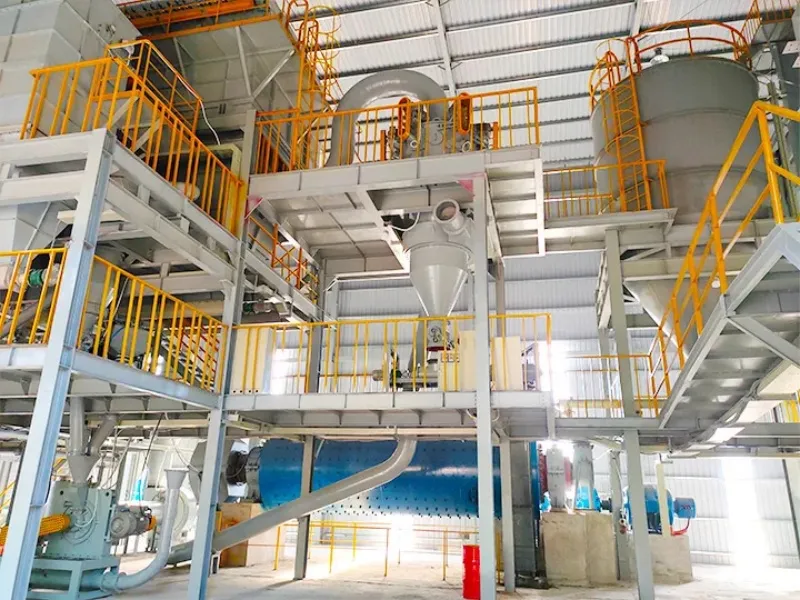
3. The Benefits of Precise PSD Control
Controlling the particle size of barite isn’t just a technical preference; it is a massive economic driver.
Optimized Oil Absorption
For the pigment and filler industry, barite is valued for its “low oil absorption” property. A precise PSD—specifically one with a narrow distribution (low Span)—ensures that the small particles fill the gaps between larger ones without creating excessive surface area. This allows for higher filler loading in plastics and paints, significantly reducing the cost of expensive binders and resins.
Rheological Control in Drilling
In deep-sea drilling, the mud must be heavy but pumpable. Over-ground barite increases the “Low Shear Rate Viscosity,” making it difficult to restart circulation after a break. Precise control allows for a “clean” cut-off at the fine end, ensuring the mud maintains a high specific gravity with a low viscosity profile.
Energy Efficiency
Grinding is the most energy-intensive part of mineral processing. Statistics show that up to 80% of the energy in a poorly managed ball mill is wasted on over-grinding fines that are already below the target size. Precise control translates directly into reduced kilowatt-hours per ton.
4. Step-by-Step Implementation Guide
To transform a standard barite grinding circuit into a precision operation, follow these four critical steps:
Step 1: Media Grading and Charge Optimization
Discard the “one-size-fits-all” approach to steel balls.
- Action: Calculate the Optimal Ball Diameter (b) based on the feed size F80. For barite, use a higher proportion of smaller balls (e.g., 20-30 mm) to maximize the number of contact points.
- Target: Increase the “Surface Area of Grinding Media” per ton of material.
Step 2: Implement a Closed-Circuit Classification
An open-circuit ball mill is almost guaranteed to over-grind.
- Action: Integrate a high-efficiency Air Classifier (for dry grinding) or a Hydrocyclone (for wet grinding).
- Process: Set the classifier to remove particles the moment they reach the target fineness. The “over-size” is returned to the mill (circulating load). A high circulating load (200-400%) is actually preferable for barite because it reduces the “residence time” of any single particle inside the mill, preventing it from being over-crushed.
Step 3: Mill Ventilation and Temperature Control
Overheating promotes the chemical activity of surface ions, leading to caking.
- Action: Optimize air flow through the mill (1.2-1.5 m/s air speed).
- Benefit: Proper ventilation pulls out “stray” fines immediately and keeps the internal temperature below 100°C, preventing moisture-driven agglomeration.
Step 4: Real-time PSD Monitoring
You cannot control what you do not measure.
- Action: Install an In-line Laser Diffraction Analyzer.
- Feedback Loop: Link the analyzer to the classifier fan speed and the mill feed rate. If the D97 starts to drift, the system automatically increases the classifier speed or reduces the feed to compensate.
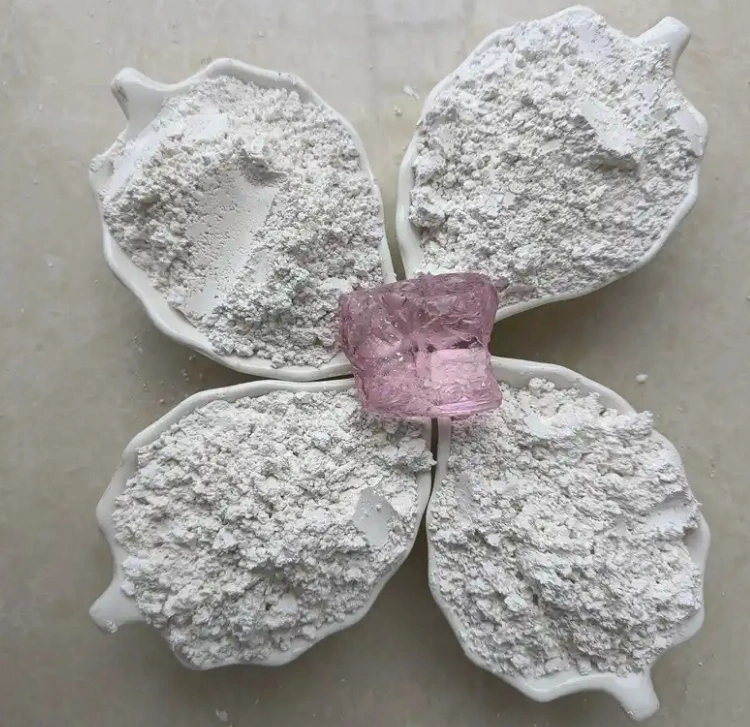
5. Practical Results and Outcomes
The following results represent typical improvements observed when transitioning from traditional “brute force” grinding to a precisely controlled barite circuit:
Result A: Throughput vs. Fineness
In a 10-ton-per-hour barite plant in Southeast Asia, implementing a closed-circuit system with optimized media grading resulted in a 25% increase in throughput while maintaining a D97 of 1250 mesh (10/mum). Previously, the plant struggled with “blinding” of the mill diaphragms due to over-ground fines.
Result B: Oil Absorption Reduction
A chemical-grade barite producer reduced the oil absorption value of their product from 22 g/100g to 16 g/100g simply by tightening the PSD span. The “long tail” of sub-micron particles was reduced by 40%, allowing them to command a 15% premium price in the high-end coating market.
Result C: Energy Savings
By utilizing polycarboxylate-based grinding aids, a mining operation reduced its specific energy consumption from 45 kWh/t to 36 kWh/t. The additive prevented the barite from “sticking” to the balls, allowing the mechanical energy to be used for particle breakage rather than overcoming internal friction.
Conclusion
Barite is a “gifted” mineral with high utility, but its delicate physical nature requires a sophisticated approach to comminution. By moving away from high-impact, long-residence-time grinding and embracing closed-circuit, attrition-based systems with chemical assistance, manufacturers can eliminate the plague of over-grinding. The result is a superior product, a more efficient factory, and a significantly healthier bottom line

“Thanks for reading. I hope my article helps. Please leave a comment down below. You may also contact Zelda online customer representative for any further inquiries.”
— Posted by Emily Chen
 English
  العربية
  Español
  Português
  Français
  Türkçe
  Tiếng Việt
  Русский