
A ball mill is one of the most common and important grinding devices in industrial applications. It can be found in virtually every industry that requires solid materials to be pulverized into fine powder — from cement plants grinding clinker, to mining operations finely milling ore, to ceramics, chemicals, pharmaceuticals, and the preparation of new energy materials.
What is a ball mill, and how does it actually grind material?
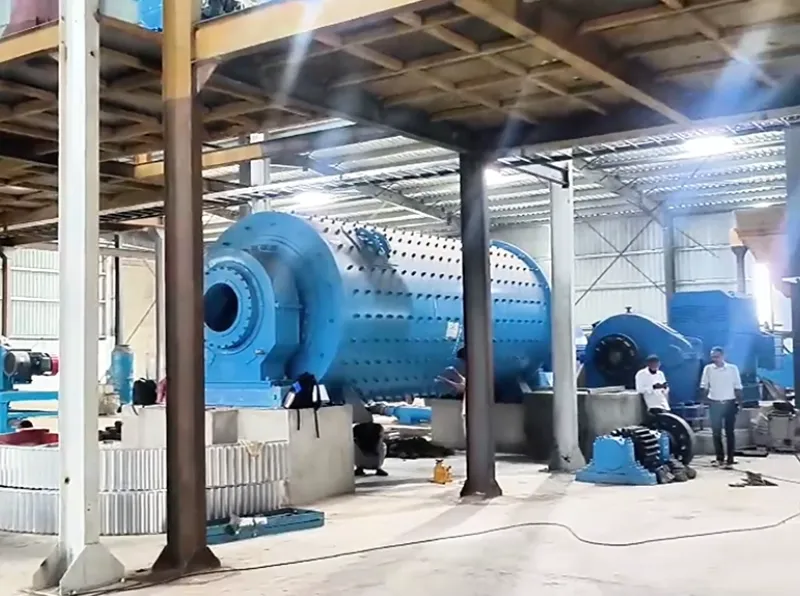
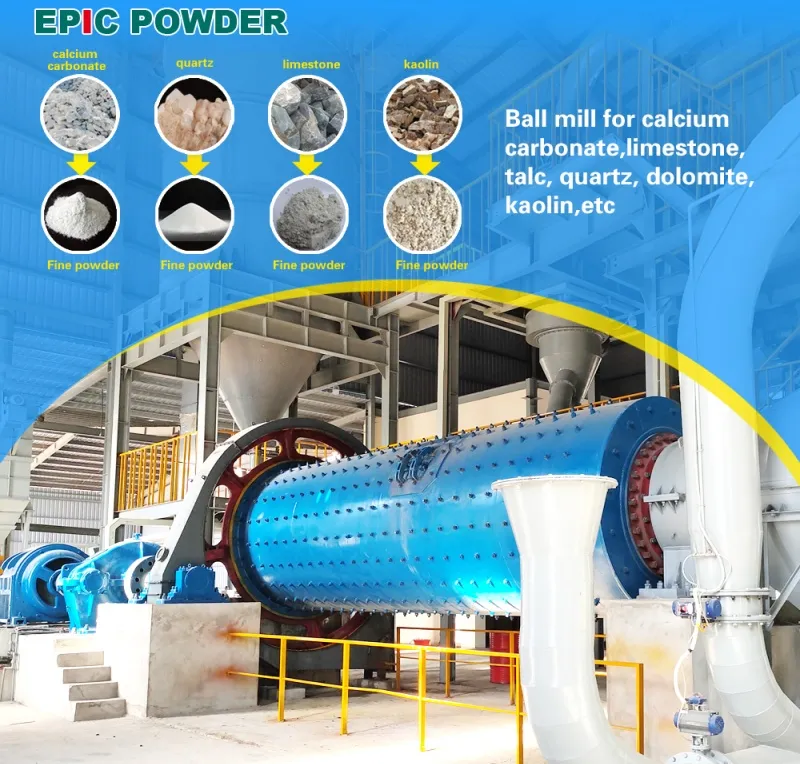
Picture this: a huge steel cylinder (ranging from less than 1 meter to over 8 meters in diameter, and several to over ten meters in length) lies horizontally and rotates slowly around its central axis. Inside the cylinder are large quantities of grinding media (most commonly steel balls, but also steel rods, ceramic balls, alumina balls, etc.) along with the material to be crushed.
When the cylinder rotates at an appropriate speed (typically 70%–85% of its critical speed), the balls and material inside exhibit three main types of motion:
- Cascading motion (the most common and efficient working state): Balls are carried up by the rotating wall to a certain height, then cascade down like a waterfall, crashing onto the material and balls below and delivering powerful impact breakage.
- Cataraating / parabolic trajectory motion (at higher speeds): Balls are thrown higher and follow a near-parabolic path before falling, producing even stronger impact forces — but this also accelerates liner and ball wear.
- Centrifugal motion (when speed equals or exceeds critical speed): Balls stick tightly to the wall and rotate with the cylinder with almost no relative movement — grinding efficiency drops sharply (industrial operations deliberately avoid prolonged running in this regime).
In addition to impact crushing, there is also extensive attrition / abrasive grinding between balls, between balls and material, and between balls and liners, which further reduces particle size and strips mineral surfaces.
In one sentence: A ball mill works by using a rotating cylinder to lift, drop, tumble, and roll its grinding media (mainly steel balls), pulverizing material through the combined action of powerful impacts and continuous abrasion.
Basic Structure of a Ball Mill
Although sizes and applications vary, the core components are generally the same:
- Cylinder / Shell: The main body, usually fabricated by rolling and welding steel plates; the inner surface is protected by wear-resistant liners (high-manganese steel, high-chromium cast iron, rubber, ceramic, etc.).
- End covers & trunnions: Hollow shafts at both ends for feeding and discharging, supported on main bearings.
- Main bearings: Support the entire rotating mass (tens to hundreds of tons); usually sliding or rolling bearings.
- Drive system: Motor → gearbox → pinion & girth gear (edge drive) or direct coupling (central drive) to rotate the cylinder.
- Feed & discharge devices: Spiral feeders, combined feeders, grate plates + pulp lifters, etc., depending on type.
- Grinding media: Steel balls (most common), cylpebs, rods, etc.; media filling usually occupies 30%–50% of the effective cylinder volume.
Main Classifications of Ball Mills
| Classification Basis | Main Types | Typical Characteristics & Applications |
|---|---|---|
| By discharge method | Overflow ball mill | Simple structure, coarser product; commonly used for primary coarse grinding |
| Grate ball mill | Grate plate + pulp lifter for forced discharge; higher capacity, finer product; often used for secondary fine grinding | |
| By grinding mode | Dry ball mill | Little or no water; product is dry powder; used when moisture is unacceptable (ceramics, some chemicals) |
| Wet ball mill | Operates with water/slurry; higher grinding efficiency; product is slurry; dominant in mining & cement | |
| By length-to-diameter ratio | Short barrel mill (L/D < 1) | Mainly for coarse grinding or open-circuit milling |
| Long barrel mill (L/D ≈ 1–2) | Most common; single- or multi-compartment fine grinding | |
| Tube mill (L/D > 2, even 4–7) | Multi-compartment (2–4 common in cement); produces very fine product | |
| By special application | Cement mill | Multi-compartment with special liners and diaphragms |
| Ceramic ball mill | Ceramic or rubber lining + ceramic media to avoid iron contamination | |
| Planetary / stirred / vibratory mills | Lab or ultra-fine applications; extremely high energy density |
Major Application Fields
- Mining & Mineral Processing (largest user base)
Copper, iron, gold, lead-zinc, nickel, lithium ores, etc. — almost every metallic and many non-metallic ores require fine grinding after crushing to achieve mineral liberation for flotation, magnetic separation, leaching, etc. - Cement Industry
Raw meal grinding, coal pulverization, clinker + supplementary cementitious materials combined grinding; tube mills remain mainstream despite partial replacement by vertical roller mills and roller presses in some cases. - Silicate & Building Materials
Production of various cements, mortars, wall materials, thermal insulation products — all require ultra-fine powders. - Chemical & Non-metallic Mineral Deep Processing
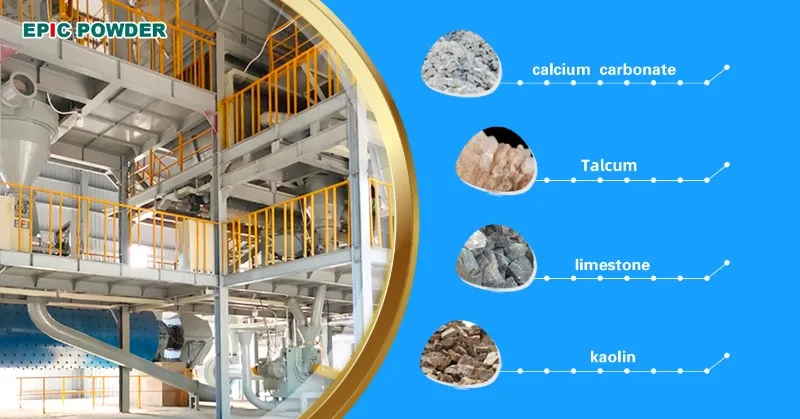
Ground calcium carbonate, precipitated calcium carbonate, talc, kaolin, bentonite, graphite, mica, wollastonite, calcined kaolin, etc. - New Energy Materials
Lithium battery cathode/anode materials (LFP, NCM, silicon-carbon anodes, graphite), solid-state electrolytes, sodium-ion battery materials — demand for ultra-fine, uniform, high-surface-activity powders drives widespread use of planetary and stirred mills. - Pharmaceutical, Food & Cosmetics
Applications requiring no metal contamination commonly use ceramic-lined mills with ceramic media.
Advantages and Disadvantages of a Ball Mill
Clear advantages:
- Extremely versatile — can process materials across almost the entire hardness range (Mohs 1–9)
- Wide adjustable product fineness (from tens of microns down to sub-micron in some cases)
- Relatively simple structure, reasonable manufacturing and maintenance costs
- Suitable for dry or wet grinding, open or closed circuit, single or multiple units in series/parallel
- Large single-unit capacity — up to hundreds of tons per hour
Main drawbacks (the reasons newer mill types are competing):
- Very high energy consumption — specific energy use is dozens of times higher than crushing; a major electricity cost item in cement and mining
- High media and liner consumption — premium high-chrome balls and liners are expensive; annual consumption is substantial
- High noise and dust (especially dry grinding)
- Large starting current, heavy impact on power grid
- Low efficiency for ultra-fine grinding (especially d97 < 2 μm) — requires long grinding times, leading to high energy use, temperature rise, and contamination
Development Trends of Ball Mills (2025–2030 Perspective)
Although ball mills have a history of over a century, they have not been completely replaced. Current and near-future development directions include:
- Larger scale — mining units now reach φ8.5 m × 13 m or bigger, with single-unit throughput of 400–600 t/h+
- Intelligent operation — online monitoring and automatic control of load, ball-to-material ratio, pulp density, liner wear, media addition, etc.
- Media optimization — higher cost-performance wear-resistant materials (ceramic-composite balls, nano-modified high-chrome balls, etc.)
- Hybrid processes — high-pressure grinding rolls + ball mill, vertical mill + ball mill, tower mill + ball mill combinations dramatically reduce system energy consumption
- Yielding ultra-fine territory — for d90 < 1 μm or sub-micron powders, more and more tasks are shifting to higher energy-density equipment such as stirred mills, jet mills, vibratory mills, planetary mills, bead mills
The ball mill is like the “reliable workhorse” of industrial powder processing — not flashy, not glamorous, but solid, dependable, and extremely adaptable. Over the next decade it will likely remain the dominant equipment for most medium-to-fine grinding tasks, only becoming smarter, larger, and greener.
The next time you see that rumbling, slowly turning giant in a cement plant or concentrator, remember: it is quietly using the most primitive methods of “smashing” and “rubbing” to turn rock day after day into the fine powder raw materials our modern life depends on.

“Thanks for reading. I hope my article helps. Please leave a comment down below. You may also contact Zelda online customer representative for any further inquiries.”
— Posted by Emily Chen
 English
  العربية
  Español
  Português
  Français
  Türkçe
  Tiếng Việt
  Русский