
Mica refers to a group of mica minerals. They are potassium, magnesium, iron, lithium, and other metal aluminosilicates. All of them have a layered structure. From a formation perspective, mica is divided into natural mica and synthetic mica. Natural mica includes biotite, phlogopite, muscovite, lepidolite, sericite, fuchsite, and siderophyllite. Among them, muscovite, sericite, phlogopite, and lepidolite are the most widely used in industry. Manufacturers often process these minerals into mica powder for industrial applications.
Synthetic mica is produced by simulating the composition of natural mica. Manufacturers mix metal oxides in precise ratios. They melt the mixture at high temperatures. The material then cools and recrystallizes to form synthetic mica. This process forms highly pure mica crystals.
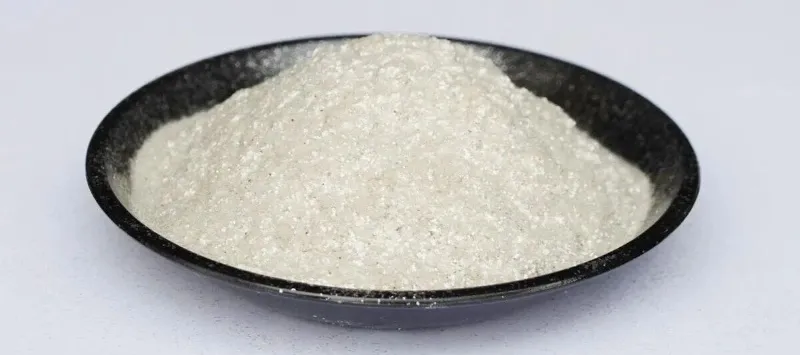
Muscovite (White Mica)
Muscovite has a chemical composition of KAl₂(AlSi₃O₁₀)(OH)₂, crystallizes in the monoclinic system, and is a layered silicate mineral similar to biotite. It typically appears in platy or scaly aggregates with a pearly luster on cleavage faces. Its hardness is 2.5–3, and thin sheets are elastic. Density is 2.76–3.10 g/cm³.
Muscovite is the most widely used type of mica in industry. Ultrafine muscovite powder serves as a functional filler in plastics, coatings, paints, and rubber, improving mechanical strength, toughness, adhesion, aging resistance, and corrosion resistance.
Industries value muscovite for its insulating properties, heat resistance, acid and alkali resistance, compressive strength, and excellent cleavage. Manufacturers use it as insulation for electrical equipment and components. They also use it in boiler windows, furnace viewing ports, and various mechanical parts.
Manufacturers process mica flakes and mica powder into mica paper, which replaces natural mica sheets and provides uniform, low-cost insulating materials.
Wet-ground muscovite with high aspect ratio is an excellent substrate for pearlescent pigments.
Sericite
Chemists consider sericite chemically very similar to muscovite and regard it as a fine-grained variety of muscovite.
Sericite aggregates can appear rose-colored, flesh-red, gray-green, light gray-purple, or dark gray. However, the powder is always white. With iron substitution in the crystal lattice, the powder becomes grayish-white and brightness decreases. Sericite occurs as fine scales (generally <0.01 mm) and has a smooth texture.
Sericite has a strong silky luster, is transparent to translucent, and provides moderate light transmission and coverage, with the ability to reflect ultraviolet light. These properties give sericite unique application value.
Because sericite occurs as small flakes, it is widely used in coatings, papermaking, cosmetics, and rubber–plastic industries.
Phlogopite (Golden Mica)
Natural phlogopite includes dark and light varieties. It is characterized by perfect mica cleavage, yellow-brown coloration, and a gold-like reflective surface. One distinguishing property is that phlogopite dissolves in boiling sulfuric acid to form a milky solution, whereas muscovite does not.
Its basic properties are similar to muscovite. It is differentiated by its brown to golden color. Compared with black mica, its color is lighter.
Industries widely use phlogopite in building materials, fire-protection products, fire extinguishing agents, welding electrodes, plastics, electrical insulation materials, papermaking, asphalt paper, rubber, and pearlescent pigments.
Ultrafine phlogopite powder serves as a functional filler in plastics, coatings, paints, and rubber, improving mechanical strength, toughness, adhesion, aging resistance, and corrosion resistance. Its additional features include excellent electrical insulation, chemical resistance, flexibility, sliding ability, heat insulation, and low thermal expansion coefficient. High-purity flakes possess smooth surfaces, high aspect ratios, regular morphology, and strong adhesion.
Industries value phlogopite for its insulation, heat resistance, acid/alkali resistance, compressive strength, and cleavage, and they use it in insulation components, furnace windows, boiler components, and mechanical parts.
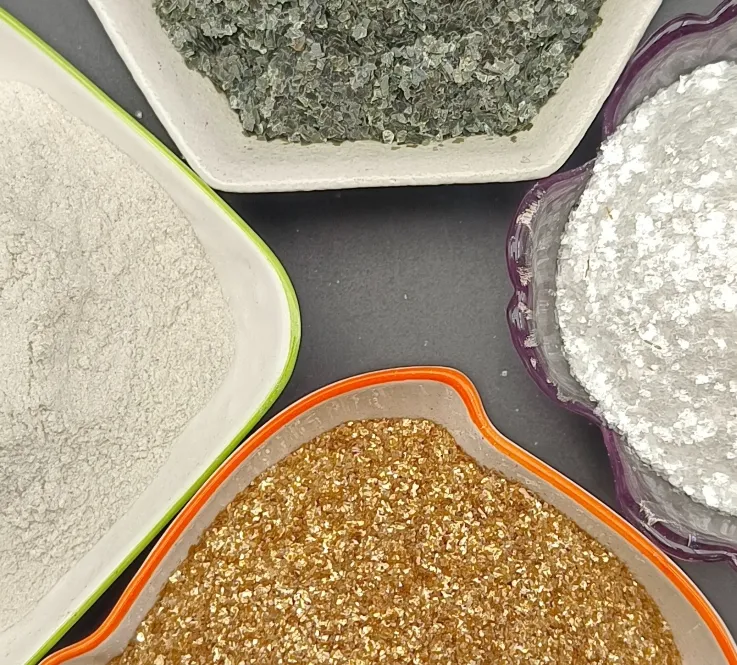
Synthetic Mica
Synthetic mica—also called fluorophlogopite—is produced by melting a mixture of raw materials (such as quartz and metal oxides) at high temperatures and then allowing them to crystallize under controlled conditions.
Compared with natural mica, synthetic mica is not limited by natural resource conditions. Its structure is similar to natural mica but offers superior purity, transparency, insulation, and heat resistance. Therefore, in many industrial applications, synthetic mica can fully replace or even surpass natural mica. Industries consider it a strategic new non-metallic, sheet-shaped material.
Manufacturers crush synthetic mica into various particle sizes and use it in coatings, rubber, plastics, mica paper, mica ceramics, special electromagnetic shielding materials, synthetic mica heating plates, machinable ceramics, and synthetic mica pearlescent pigments.
Wet-ground synthetic mica powder retains the silky texture and pearly effect of natural mica but offers better whiteness, lower heavy-metal content, and fewer impurities.
The high transparency of synthetic mica crystals ensures consistent color intensity in cosmetic formulations. Manufacturers widely use these products in pressed powders, loose powders, eye shadows, foundations, blushes, and more.
Mica Processing Technologies
Manufacturers primarily process mica into powder using three major methods: the dry method, the wet method, and the vapor-phase method.
Dry Processing
Dry processing refers to directly grinding mica into powder using mechanical mills.
Process flow:
Ore selection → coarse crushing → semi-finished processing → purification → grinding → classification → packaging → final product
Advantages of dry grinding:
- Simple process; fewer machines and shorter production lines
- No need for water or heat; low energy demand
- Low product cost; suitable for low-end filler-grade applications
- Higher production efficiency compared with wet grinding
Disadvantages of dry grinding:
- Lower precision; poor aspect ratio, resulting in coarse texture
- Higher impurity content
- Poor working environment; significant dust pollution
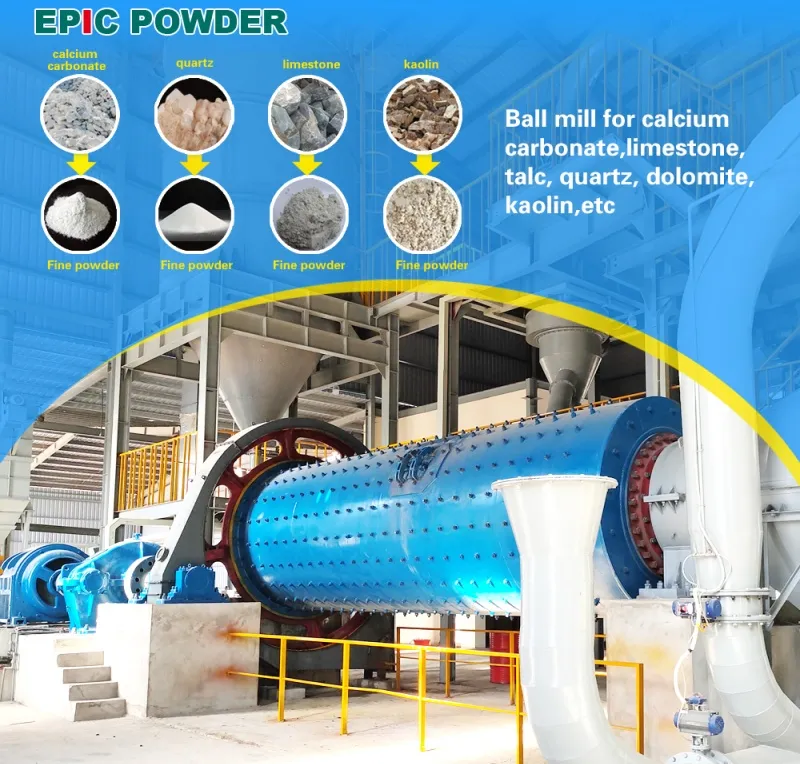
Wet Processing
Wet processing uses water (and grinding aids) during milling. Manufacturers use sedimentation or centrifugation after grinding to classify the powder and obtain the desired particle size.
Process flow:
Mica flakes → hydro-breaking → initial screening → grinding → classification → solid-liquid separation → drying → packaging → final product
Advantages of wet grinding:
- High-precision process; narrow particle size distribution, high aspect ratio, smooth feel
- Multiple stages of impurity removal; very low impurity content
Disadvantages of wet grinding:
- High energy consumption
- Low production efficiency
- Higher product cost; mainly used for high-end applications
- Complex process; highly dependent on operator experience
Epic Powder
Epic Powder, 20+ years of work experience in the ultrafine powder industry. Actively promote the future development of ultra-fine powder, focusing on crushing, grinding, classifying and modification process of ultra-fine powder. Contact us for a free consultation and customized solutions!Our expert team dedicates itself to providing high-quality products and services that maximize the value of your powder processing. Epic Powder—Your Trusted Powder Processing Expert !

“Thanks for reading. I hope my article helps. Please leave a comment down below. You may also contact Zelda online customer representative for any further inquiries.”
— Posted by Emily Chen
 English
  العربية
  Español
  Português
  Français
  Türkçe
  Tiếng Việt
  Русский