
In non-metallic mineral processing, product purity dictates market value. For high-end kaolin clay, the Ceramic Lined Ball Mill for Kaolin Grinding is an essential solution. Global demand for high-brightness paper and precision ceramics is increasing. Manufacturers must achieve ultrafine particle sizes. However, they must also preserve the mineral’s natural whiteness. The primary challenge is “Iron Contamination.” This factor can downgrade premium raw materials into low-grade industrial filler.
The Critical Challenge: Why Iron Contamination Matters
Industry experts prize kaolin, or “china clay,” for its chemical inertness, high opacity, and brilliant white color. However, these properties are extremely sensitive to metallic impurities. During traditional grinding, standard steel liners or steel media create microscopic iron particles through constant friction and impact. These particles mix with the kaolin powder.
This contamination leads to several critical issues:
- Reduced Whiteness: Even a trace amount of Fe2O3 (iron oxide) can cause a yellowish or grayish tint. This makes the kaolin unsuitable for high-grade paper coating or cosmetic applications.
- Sintering Defects: In the ceramic industry, iron impurities cause dark spots or “specks” during high-temperature firing. This ruins the aesthetic and structural integrity of fine porcelain.
- Chemical Instability: For catalysts and rubber fillers, metallic iron can trigger unwanted chemical reactions. This shortens the lifespan of the end product.
To combat these issues, the Ceramic Lined Ball Mill for Kaolin Grinding provides a “metal-free” environment. It ensures that the ultrafine powder retains its original mineralogical purity.
Technical Analysis: The Architecture of Purity
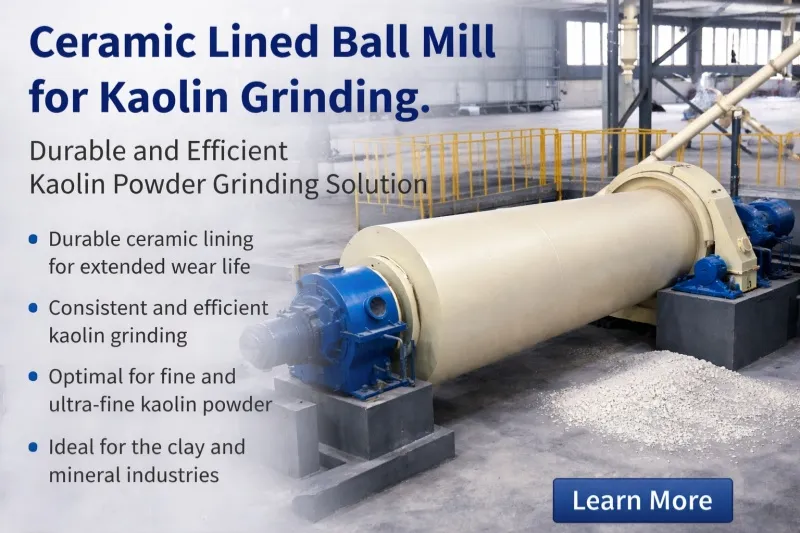
A Ceramic Lined Ball Mill for Kaolin Grinding differs from conventional mills through its specialized internal materials and engineering precision. At its core, the goal is to replace every possible metal-to-mineral contact point with high-performance industrial ceramics.
1. High-Alumina Ceramic Linings
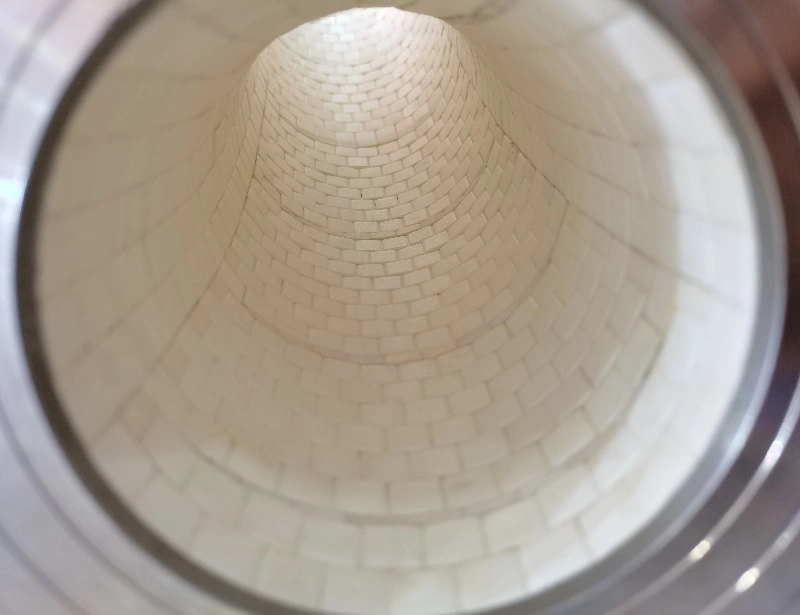
We meticulously tile the mill drum interior with high-density alumina (Al2O3) or zirconia-toughened alumina (ZTA) blocks. These ceramics boast a Mohs hardness of 9, significantly higher than most minerals and standard steel.
- Wear Resistance: These linings offer a service life 5–10 times longer than manganese steel in abrasive environments.
- Zero-Carbon/Zero-Iron: Because the lining is made of inert oxides, any microscopic wear-off is chemically compatible with the kaolin. It does not affect the color.
2. Specialized Grinding Media
The choice of “balls” is just as critical as the lining. A Ceramic Lined Ball Mill for Kaolin Grinding typically utilizes high-alumina ceramic balls or silicate-based media.
- Density vs. Purity: While steel balls are heavier and grind faster, ceramic balls provide a gentler, more uniform grinding action. This is ideal for producing the “platy” structure required in high-end kaolin.
- Energy Efficiency: The lighter weight of ceramic media reduces the starting torque and operational energy consumption of the mill.
Achieving Ultrafine Fineness: 325 Mesh to Sub-Micron
In the world of SEO and industrial procurement, “Fineness” is the most searched parameter.
The Grinding Mechanism
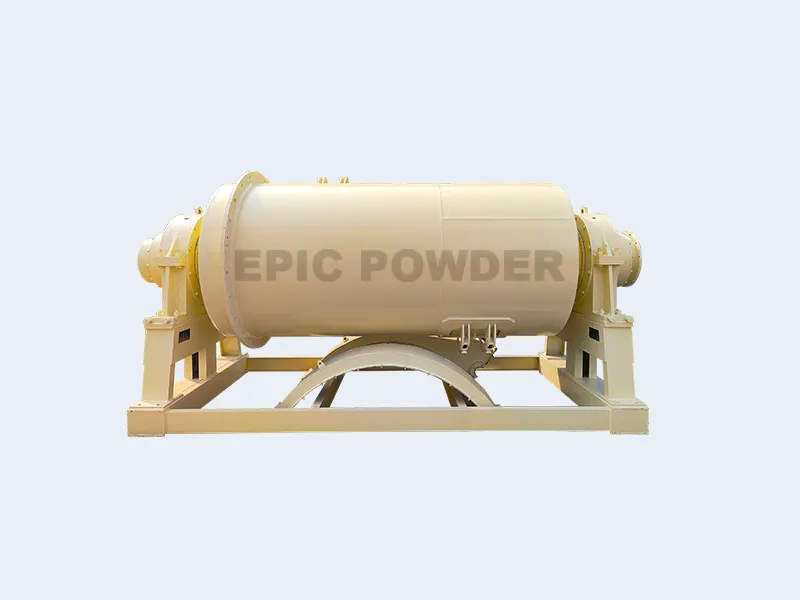
The Ceramic Lined Ball Mill for Kaolin Grinding employs a combination of impact and attrition. As the mill rotates, the ceramic media is lifted and dropped onto the kaolin slurry (in wet grinding) or dry feed. For ultrafine powder production, the “attrition” (rubbing) force is more important than the “impact” force.
Integration with Air Classifiers
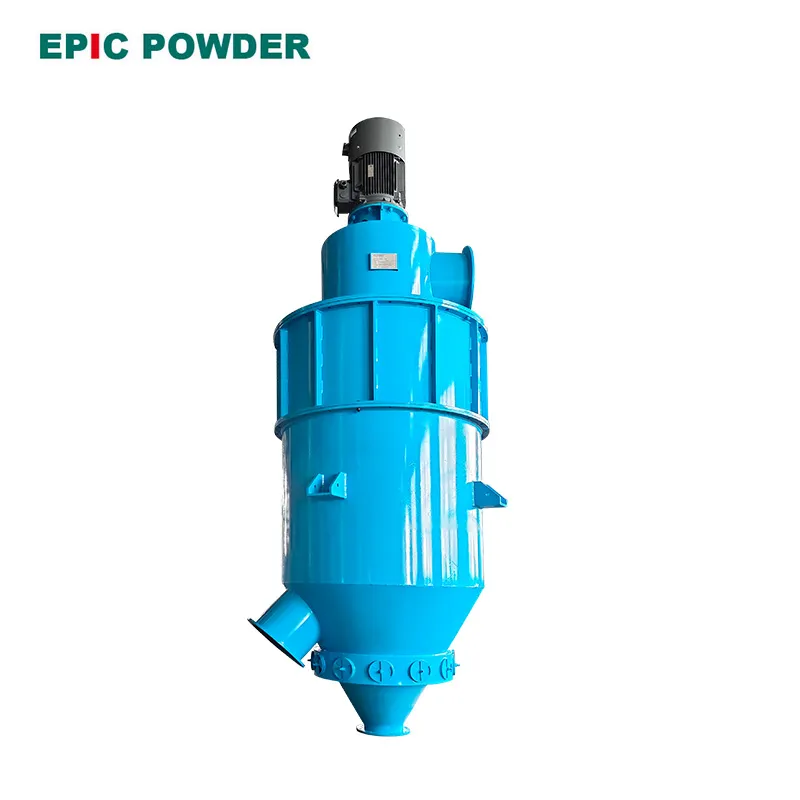
To reach the ultra-thin, platy particle shapes required for “paper grade” kaolin, the ball mill often works in a closed-loop system with a Turbo Air Classifier.
- Feed: Raw kaolin enters the ceramic-lined mill.
- Grinding: Ceramic media reduces the particles.
- Classification: The powder is pulled into an air classifier. Fine particles that meet the 1250–5000 mesh target are collected.
- Recycle: Over-sized particles are returned to the mill for further processing.
This system ensures a narrow Particle Size Distribution (PSD), which is a “long-tail keyword” often used by technical engineers looking for consistent quality.
Economic Benefits and ROI: Beyond the Initial Investment
Although a Ceramic Lined Ball Mill for Kaolin Grinding costs more initially than a standard iron-lined mill, it delivers a high Return on Investment (ROI) through three main avenues:
1. Market Premium
High-purity, iron-free kaolin can command a price 30% to 100% higher than standard industrial clay. By eliminating iron contamination, producers can enter the lucrative markets of electronics, specialty glass, and pharmaceuticals.
2. Lower Downstream Processing Costs
If iron is introduced during grinding, it must be removed later using high-gradient magnetic separators (HGMS) or chemical bleaching. These processes are expensive and environmentally taxing. Preventing contamination at the source with a Ceramic Lined Ball Mill for Kaolin Grinding reduces or even eliminates the need for these costly steps.
3. Reduced Maintenance Downtime
Alumina ceramics are incredibly resistant to chemical corrosion. If your kaolin processing involves acidic or alkaline slurries, a ceramic lining will not corrode, unlike steel which would pit and fail rapidly.
Why Epic Powder’s Solution Stands Out
Epic Powder understands that every kaolin deposit is unique. Some are “harder” and require higher-impact energy, while others are “softer” and require delicate attrition to preserve the flake structure.
Our Ceramic Lined Ball Mill for Kaolin Grinding is designed with:
- Precision-Fit Lining Technology: We use a specialized “locking” brick design that prevents lining blocks from falling out, even under intense vibration.
- Advanced Seal Designs: We ensure that no lubricant or external contaminants can enter the grinding chamber.
- Variable Frequency Drives (VFD): This allows operators to adjust the mill speed to find the perfect “cataracting” or “cascading” motion for different grades of kaolin.
Conclusion: Elevating Your Mineral Value
The choice of equipment is a direct reflection of a company’s commitment to quality. Utilizing a Ceramic Lined Ball Mill for Kaolin Grinding is not just a technical preference; it is a strategic business decision to safeguard the purity of your ultrafine powder. By preventing iron contamination, you ensure that your kaolin meets the highest international standards, opening doors to premium global markets.
Whether you are upgrading an existing facility or designing a new non-metallic mineral grinding solution, focusing on the synergy between durability and purity is the path to long-term profitability.
Optimize Your Production Today
Are you struggling with color consistency in your kaolin powder? Or are your maintenance costs for steel liners cutting into your margins? Epic Powder provides turnkey solutions for high-purity mineral processing.
Would you like me to provide a specific capacity calculation (TPH) for your kaolin project? Or send you the technical specifications for our 1250-mesh ceramic ball mill series?
“Thanks for reading. I hope my article helps. Please leave a comment down below. You may also contact Zelda online customer representative for any further inquiries.”
— Posted by Emily Chen
 English
  العربية
  Español
  Português
  Français
  Türkçe
  Tiếng Việt
  Русский