
In the field of industrial powder processing, achieving large-scale, high-efficiency, and low-cost production is a key concern for every plant operations manager and project engineer. Among the various grinding equipment available, the continuous ball mill has become the workhorse in several industries. These include mineral processing, cement manufacturing, new building materials, and large-scale fine mineral processing. Its popularity comes from its unique structure and operating mechanism.
So, why are continuous ball mills generally considered superior to batch ball mills in large-scale industrial grinding? The core technical advantages and economic benefits behind this are primarily reflected in the following four key dimensions:
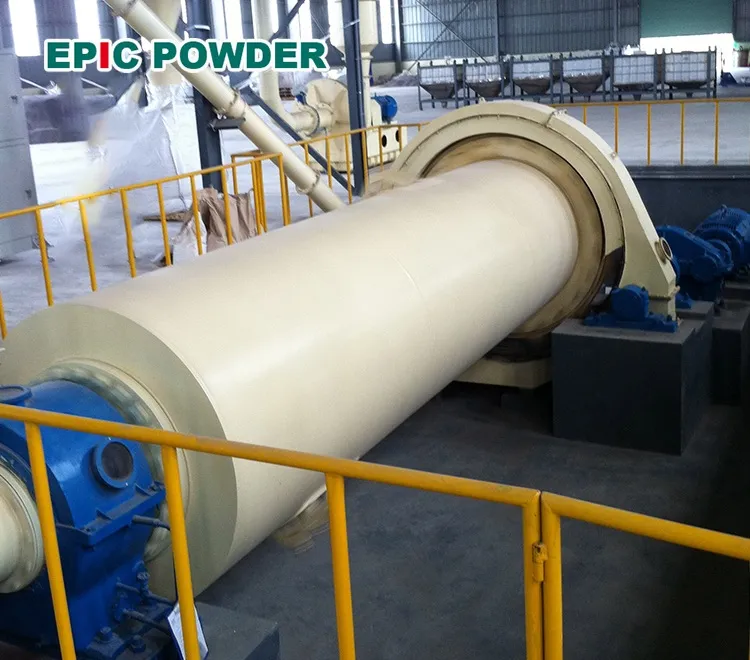
Say Goodbye to Downtime: Achieve Uninterrupted Production Capacity
This is the most notable physical characteristic of continuous ball mills. Traditional batch ball mills follow a cyclical process of “loading—grinding—shutdown—unloading.” There is a significant amount of idle downtime between each batch.
Continuous Feed and Discharge, Zero Time Wasted:
The continuous ball mill features a dual-end open design (one end for feeding, the other for discharging). After entering through the feed end, the material moves toward the discharge end within the rotating cylinder while being impacted by grinding media (steel or ceramic balls).
Perfectly Suited for Automated Production Lines:
Because it can “take in coarse material and produce fine powder,” it integrates seamlessly with upstream crushers and feeders, as well as downstream air classifiers and collectors. This creates a fully automated closed-circuit production line that is ideally suited for large-scale, industrial-level, round-the-clock continuous operation.
Continuous Ball Mill Avoiding “Over-Grinding”
In large-scale production, energy consumption directly determines a product’s market competitiveness. Continuous ball mills have a natural industrial advantage in reducing energy consumption per unit (kWh/ton).
Avoiding Inefficient Energy Consumption:
In batch ball mills, by the later stages of grinding, most of the material has already reached the required fineness. However, it must remain in the grinding chamber and continue to be ground along with the rest. This not only wastes a significant amount of electrical energy but also leads to “over-grinding” of the powder.
Dynamic Balancing and Dynamic Discharge:
Continuous ball mills are equipped with forced discharge mechanisms (such as grid-type) or overflow discharge mechanisms. Once particles reach the fineness required for hydrodynamic or mechanical discharge, they are immediately removed from the mill.
Economies of Scale at High Throughput:
Under high-capacity demands, continuous ball mills eliminate the massive inrush current consumption associated with frequent motor starts and stops. Their operating current is more stable, and energy consumption per unit of output is typically 20% to 30% lower than that of intermittent equipment with equivalent total output.
Product Consistency
In modern industry, the consistency of product quality is even more critical than the fineness itself. If the particle size distribution (PSD) of each batch of powder fluctuates between coarse and fine, subsequent operations (such as blending, sintering, and chemical reactions) will be difficult to sustain.
Industrial Challenge:
Batch ball mills are highly prone to inter-batch quality fluctuations. Manual operation introduces randomness into the process. Small variations in the water-to-feed ratio can affect product quality. Minor changes in grinding time can also lead to inconsistent results.
Continuous ball mill perfectly address this challenge through a highly automated control system:
The system uses a variable-frequency feeder and a water flow meter to precisely control the solid-to-liquid ratio (wet grinding) or feed rate (dry grinding). The retention time of the material within the mill is constant and controllable.
When integrated with a downstream classifier for closed-circuit processing, non-conforming coarse particles are continuously returned to the process, while qualified fine powder is discharged. This results in an extremely stable and narrow particle size distribution curve for the final product.
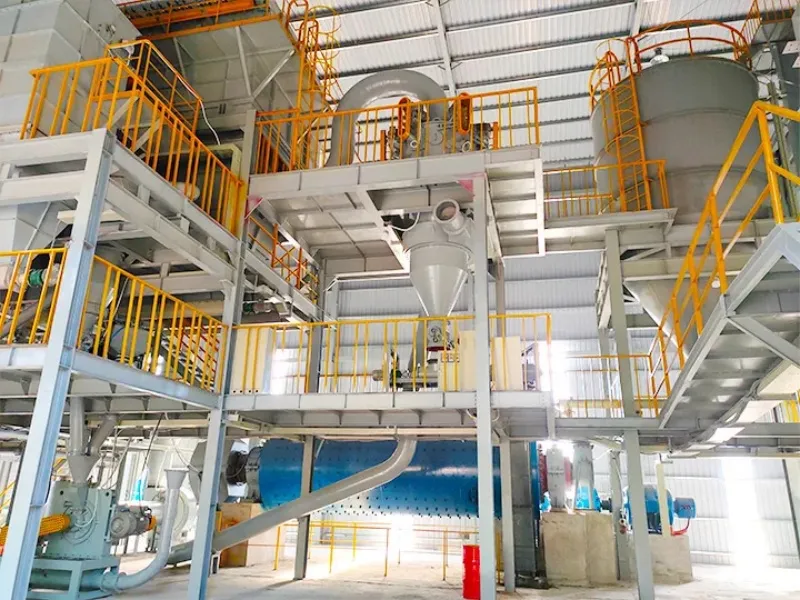
The Economic Case for Large-Scale Investment: Lower Maintenance and Labor Costs
Although the initial capital expenditure for a continuous ball mill may be higher than that of a conventional batch ball mill, from a long-term operational expenditure perspective, it offers the best return on investment (ROI) for large-scale plants.
| Evaluation Dimension | Batch Ball Mill | Continuous Ball Mill |
|---|---|---|
| Labor Requirement | Requires frequent manual operation of feed and discharge valves, resulting in high labor intensity. | Centralized control from the control room enables unattended operation. |
| Wear Part Lifespan | Frequent start-stop cycles cause severe mechanical impact on gears, reducers, and motors. | Uniform and smooth operation significantly reduces mechanical fatigue and wear. |
| Workshop Space Utilization | Multiple units need to run in parallel to achieve the same annual output, occupying a large area. | High single-machine capacity allows for compact plant design, saving on infrastructure investment. |
Summary and Selection Recommendations
When evaluating large-scale powder processing projects, “Scale determines Selection” is an ironclad rule.
If your project involves small-scale laboratory trials, small-batch production of multiple varieties of modified specialty polymer materials, or daily output ranging from just a few hundred kilograms to 1–2 tons, then a more flexible batch ball mill is the appropriate choice.
However, the situation is different for large-scale production. If your goal is to produce tens, hundreds, or even thousands of tons per day, a continuous ball mill is the preferred solution. It is widely used for industrial minerals such as calcium carbonate, quartz, and kaolin. It is also suitable for cement clinker grinding and large-scale mineral processing lines.
A continuous ball mill offers a high level of automation. It provides very low energy consumption per unit of product. It also ensures excellent product quality consistency. In addition, its operating and maintenance costs are relatively low. These advantages make it a key driver of efficiency and profitability in modern manufacturing plants.

“Thanks for reading. I hope my article helps. Please leave a comment down below. You may also contact Zelda online customer representative for any further inquiries.”
— Posted by Emily Chen
 English
  العربية
  Español
  Português
  Français
  Türkçe
  Tiếng Việt
  Русский