
Many concentrator plants have a common habit: as long as the liner is not leaking, it continues to be used. As a result, problems often appear later—grinding fineness begins to fluctuate, throughput drops, steel ball consumption increases, flotation recovery inexplicably declines, power consumption keeps rising, and cyclone return sand increases abnormally. Eventually, when the mill is stopped for inspection, the ball mill liners are already completely worn flat.
But the real issue is not that “the liner is damaged.” Rather, the grinding operating condition has already changed.
Many mines spend years optimizing reagents, flotation, and magnetic separation, yet ignore a fundamental issue: liner wear essentially changes the energy structure of the grinding process.
A liner is not just a “wear-resistant layer.” In fact, it determines the lifting height of steel balls and affects:
- Media motion trajectory and energy transfer mode
- Grinding impact energy
- Slurry movement trajectory
- Ball charge distribution state
- Effective mill volume
- Stability of classification load
Once liner wear exceeds a critical level, the entire grinding system changes. In many cases, tailings grade increase, abnormal fineness, and rising steel consumption are not caused by flotation—but by internal mill conditions.
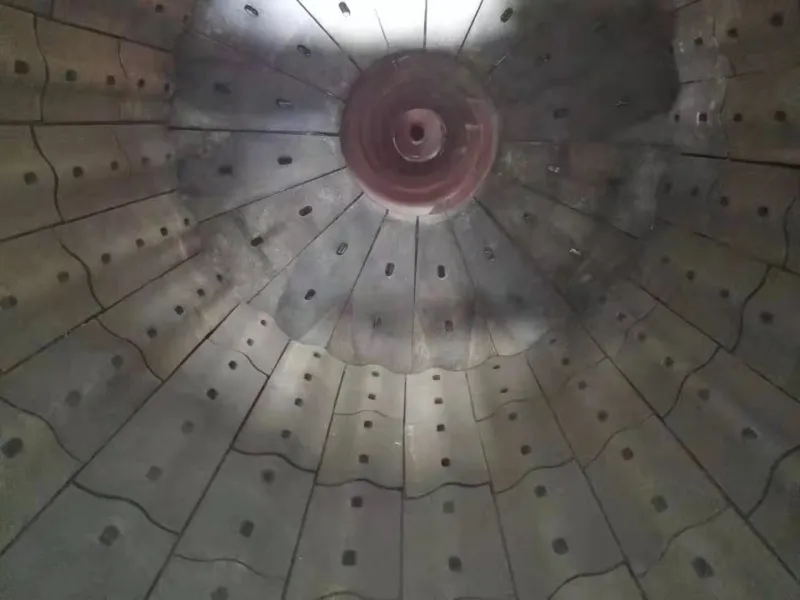
I. Why Does Grinding Performance Deteriorate After Ball Mill Liners Wear ?
Many people believe ball mill liners wear simply means “thinner thickness.” In reality, it does not. What truly affects production is the change in liner geometry, especially:
- Lifter height
- Wave peak structure
- Working angle
- Lifting capacity
These parameters determine whether steel balls are in “cataracting impact” or “cascading grinding” mode. Different mill structures and operating conditions will show different levels of impact from liner wear.
II. When the Liner Wears Flat, Effective Ball Lifting Height Drops Significantly ?
This is the most typical on-site problem. With new liners, lifters are high enough to carry steel balls to a certain height before they fall. This produces strong impact force, high coarse-particle breakage capacity, and fast discharge, resulting in high throughput. Especially in primary grinding stages: impact dominates capacity.
After ball mill liners wear, lifter height decreases, and steel balls begin to “slide” rather than “cataract.” This leads to:
- Reduced impact
- Increased abrasive grinding
- Decreased coarse particle breakage capacity
- Longer slurry residence time
A typical phenomenon appears on site: current does not drop, but throughput keeps decreasing. A portion of energy is consumed by ineffective friction between media and slurry agitation. The effective impact action inside the mill weakens, gradually shifting to low-efficiency attrition grinding.
III. Three Common Misjudgments by Many Beneficiary Plants
Increased Fineness, Mistaking it for Classification Issues
Many plants find a sudden drop in -200 mesh size. Their first reaction is: a broken hydrocyclone, a change in feed concentration, or an unreasonable steel ball gradation.
However, in many cases, it’s because the liner wears down, making it harder to crush coarse particles. This is especially true for magnetite and copper ores; once the grinding liner wears down, the crushing capacity for coarse particles decreases significantly, and the returned sand becomes increasingly coarse.
Increased Power Consumption, Mistaking it for Harder Ore
Some plants experience a sudden increase in power consumption per ton of ore, their first reaction being, “The ore has hardened recently.” In reality, after the liner wears down, the effective drop of steel balls decreases. A large amount of energy is wasted on ball-to-ball friction, ball-to-slurry friction, and ineffective sliding. The effective energy actually used for crushing the ore decreases, a typical case of decreased effective energy utilization.
Increased Steel Ball Consumption, Mistaking it for Poor Steel Ball Quality
Many on-site observations show a significant increase in steel ball consumption in the later stages of liner wear, but the problem isn’t necessarily with the steel balls. Because the liner plate wears down, the trajectory of the steel balls changes. This results in more compression, slippage, and abnormal collisions between the steel balls. As a result, the steel balls become out of round more quickly, and may even become “ellipsoidal.”
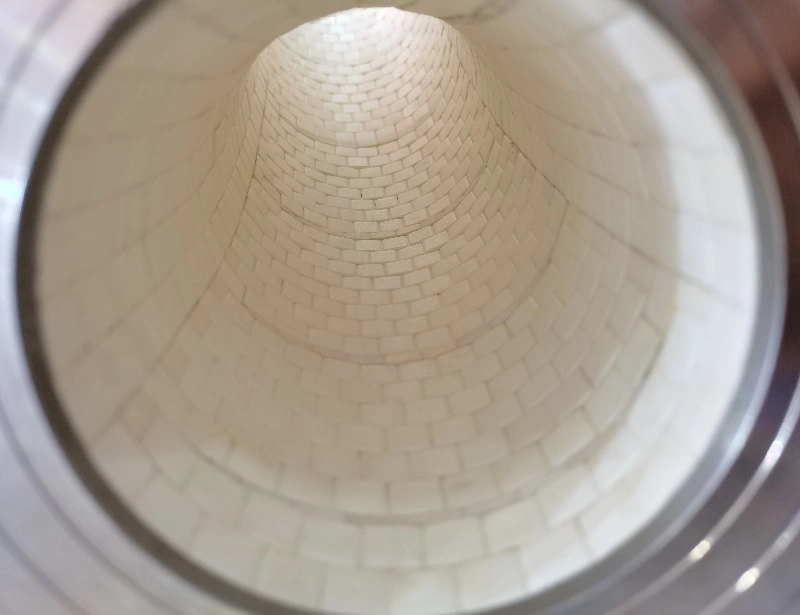
IV. At What Point Must Ball Mill Liners Be Replaced?
This is the core question. Many manufacturers have not yet established a clear standard. In reality, the truly effective judgment in the industry is not based on “thickness,” but on “whether the lifting capability has failed.”
V. Four Most Practical Replacement Criteria (Field-Based)
Note: These indicators are empirical warnings for industrial sites and cannot replace mill diagnostics, process analysis, or industrial validation.
Elevator bar wear exceeding 50%
In industrial settings, many coarse grinding systems experience a significant decrease in grinding efficiency after the elevator bars wear down to 40%–60% of their original height. However, the specific critical value still needs to be determined comprehensively based on ore properties, rotational speed, and mill structure. For example, the elevator bar height for new liners is 120mm. When wear reaches 50–60mm, many mills have already entered the inefficient zone. The impact is particularly pronounced in ball mills, coarse grinding systems, and high-hardness ores.
Throughput continuously declines (>10%) under stable ore and classification conditions
This is the most direct production indicator. Many concentrators find that: in the later stages of grinding, the feed rate to the liner is insufficient, the current is unstable, and the amount of returned sand increases. If, under conditions of no significant change in ore properties, stable classification conditions, and normal feed particle size, the grinding time continues to decline by more than 10%, the liner should be thoroughly inspected. Often, this is not a process problem, but rather an insufficient lifting capacity.
Continuous deterioration of grinding fineness
Especially an increase in coarse particles. For example: a significant increase in +0.15mm, a decrease in -200 mesh, and insufficient liberation of individual particles. This is very common in magnetite, copper, and gold ores. Because the liner can no longer break down coarse particles in the later stages.
“Wave-shaped uneven wear” on the liner
This is a very dangerous sign, indicating an imbalance in the ball load inside the mill. Continued operation can easily lead to liner breakage, loose bolts, and abnormal local stress on the cylinder. In severe cases, it may cause abnormal stress on local structures, increasing equipment safety risks.
VI. Six Core Factors Determining Liner Life
Why do some liners have such a short lifespan? Many concentrators believe that liner lifespan is only related to the material. In fact, operating conditions often have a greater impact.
- Ore Hardness: High-silica, high-quartz content ores: extremely abrasive. For example, in quartzite-type gold mines, high-silica magnetite, and skarn copper mines, the liner lifespan may only be about 60% of that of ordinary ores.
- Steel Ball Grading: Too many large balls: violent impact. This significantly increases localized damage to the liners. Many plants prioritize throughput, neglecting liner lifespan.
- Mill Speed: When the mill speed is too high, the height from which the steel balls fall increases. The impact load on the liners rises sharply. Some concentrators operate at high speeds for extended periods during sprue changes, resulting in a significantly shortened liner lifespan.
- Make-up Water System: When the slurry concentration is too low, the steel balls directly impact the liners, weakening the buffering effect. The lack of a slurry buffer layer is a significant cause of abnormal liner wear in many dry and semi-dry grinding systems.
- Feed particle size fluctuations: A sudden increase in coarse particles can lead to abrupt changes in impact load and localized abnormal wear. This is especially noticeable when the crushing system is unstable.
- Mismatched liner structure: Some mills have improperly designed lifting angles, incorrect wave crest spacing, or excessively low lifting bars, resulting in abnormal ball movement. In such cases, even with the best materials, the liner’s lifespan will be short.
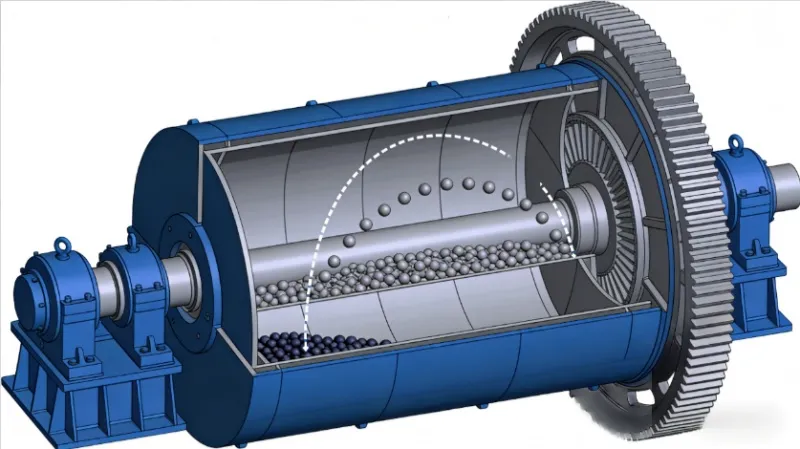
VII. Why are Many Mines Starting to Conduct Liner Condition Analysis?
Because many companies have now discovered that the liner problem is not essentially a “spare part problem,” but rather a grinding process problem.
Why can some mills use liners for 10 months while others only use them for 5 months?
The fundamental reason lies in the different grinding regimes. In recent years, some large mines have begun to use DEM discrete element analysis, ball load motion simulation, grinding power index testing, liner trajectory analysis, and mill condition optimization, not simply to extend lifespan, but to improve effective impact efficiency, unit energy utilization, and grinding liberation effect. After optimization of some projects, both mill time and media utilization efficiency have shown an improving trend.
VIII. What Many Plants Truly Waste Is Not Liners, But Delayed Replacement?
This is the most common problem on-site. Many mines, in order to save on spare parts costs, delay replacement until the liners are very thin.
As a result, power consumption increases, recovery rates decrease, operating hours decrease, and steel consumption increases. These hidden losses often far exceed the price of the liners themselves. Especially in large concentrators, a 5% decrease in the throughput of a single mill can result in losses of millions of yuan per year. However, many companies haven’t seriously considered this cost.
Truly mature concentrators have now begun to establish a “liner life database.” This includes monitoring wear in different areas, changes in operating hours, power consumption, particle size, steel consumption, and liner thickness. The optimal replacement cycle is predicted through data, rather than “replacing when it looks almost worn out.”
This essentially represents a shift from a “maintenance mindset” to a “process management mindset.” On-site observations can only serve as preliminary judgments; the final verification must be based on a comprehensive analysis of grinding tests, particle size distribution, power variations, and beneficiation indicators.
“Thanks for reading. I hope my article helps. Please leave a comment down below. You may also contact Zelda online customer representative for any further inquiries.”
— Posted by Emily Chen
 English
  العربية
  Español
  Português
  Français
  Türkçe
  Tiếng Việt
  Русский