
Baryte (BaSO₄), as one of the densest non-metallic minerals, holds a significant position in the global powder industry. To meet the diverse requirements of downstream sectors, precision baryte grinding is the critical bridging process. Its main applications include oil and gas drilling mud weighting agents (requiring 325–2000 mesh, D50 typically 5–20 μm), barium-based chemical raw materials (precursors for precipitated barium sulfate, requiring D50 < 2–5 μm or even submicron levels), high-gloss coatings/engineering plastics functional fillers (D50 0.8–3 μm, with strict particle size distribution and whiteness control), medical-grade barium sulfate (ultrafine, narrow distribution, high purity), and emerging acoustic/shielding materials.
Different end-use applications have highly varying requirements for D50, particle size distribution width (span), specific surface area, particle morphology, and impurity control. This directly determines the choice of grinding process—whether dry ball milling, wet ball milling, or more advanced combinations such as dry jet milling, wet stirred mills, or sand mills.
This article systematically compares dry ball milling and wet ball milling for baryte, considering grinding efficiency, particle size limits, energy consumption, particle shape, cost, system complexity, and practical industrial applications. The focus is to answer the core question: which ball milling process more easily achieves a lower D50?
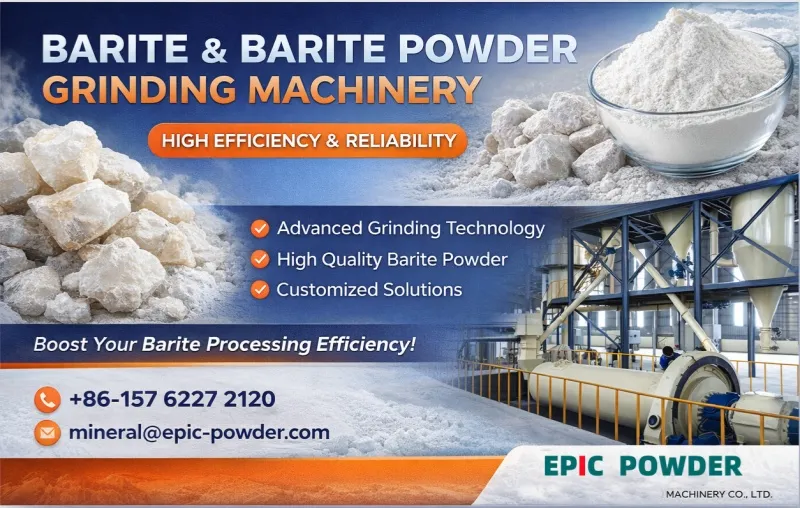
Baryte Grinding Difficulty and Tendency for “Overgrinding”
Baryte has a Mohs hardness of 3–3.5, making it a moderately soft mineral. However, it has well-developed cleavage, high brittleness, and a layered/plate-like crystal structure. This causes the mineral to fracture easily along cleavage planes under mechanical stress, producing a large number of ultrafine particles (<1 μm). This phenomenon is commonly referred to in the industry as “severe overgrinding” with a high proportion of fines and wide particle size distribution.
During ball milling, excessive fines can trigger the following chain reactions:
- Severe agglomeration of fine particles (particularly in dry milling)
- Formation of a “buffer layer” on the grinding media surface, reducing grinding efficiency
- Sharp deterioration of slurry (wet) or powder (dry) flowability
- Exponential increase in energy consumption (kWh/t) over time
Thus, ultrafine grinding of baryte (D50 <3 μm) is never simply a matter of “extending grinding time.” It requires a systematic approach involving process route, equipment selection, grinding/dispersing aids, and closed-loop classification.
Comparison of Dry Ball Milling and Wet Ball Milling Processes
| Parameter | Dry Ball Milling (Conventional/Closed Loop) | Wet Ball Milling (Conventional/Stirred/Sand Mill) | Industrial Difference Notes |
|---|---|---|---|
| Grinding Medium | Steel balls, ceramic balls, silica balls…etc | Water/dispersing medium (with optional grinding/dispersing agents) | Wet medium density ~1 g/cm³, far higher than air; stronger impact forces |
| Particle Dispersion | Easy agglomeration, severe static charge | Particles suspended, well-dispersed (Zeta potential control) | Wet milling avoids common dry milling issues such as “ball coating” and “paste formation” |
| Typical D50 Limit (Single Machine) | ~3.5–6 μm (hard lining + classifier closed loop) | ~0.5–2.5 μm (stirred/sand mill) | Wet milling can achieve much lower D50 |
| Achieving Lower D50 | Requires series of jet mills/vibratory mills/planetary mills | Sand mill + classification or multi-stage sand mill series | Industrial D50 <1 μm almost entirely relies on wet milling |
| Energy Consumption (kWh/t, to D50 ≈ 2 μm) | Relatively high (80–150) | Low to medium (40–120, depending on equipment) | Wet milling energy efficiency is higher due to dense medium |
| Particle Shape | Angular, high proportion of plate-like particles | More rounded (hydration/mechanical polishing effects) | Coatings/plastics prefer rounded particles from wet milling |
| Overgrinding Control | Very difficult (high fines proportion) | Relatively easier (aided by grinding aids + classification) | Dry milling span value often >2.0–2.5, wet milling controllable at 1.2–1.8 |
| System Complexity | Low (grinding + classification + dust collection) | High (slurry prep, dewatering, drying, dispersing agent addition) | Dry milling simpler to invest and operate |
| Applicable Fineness Range | D50 4–30 μm | D50 0.4–15 μm | — |
| Representative Equipment | Batch/continuous ball mill + turbine classifier | Horizontal/vertical stirred mill, sand mill, nano bead mill | — |
| Typical Applications | Drilling grade (325–1250 mesh), general chemical grade | High-end coatings, plastic masterbatches, medical grade, barium precursor | — |
Data sourced from multiple baryte deep-processing enterprises (2023–2026 operational data) and literature comparisons.
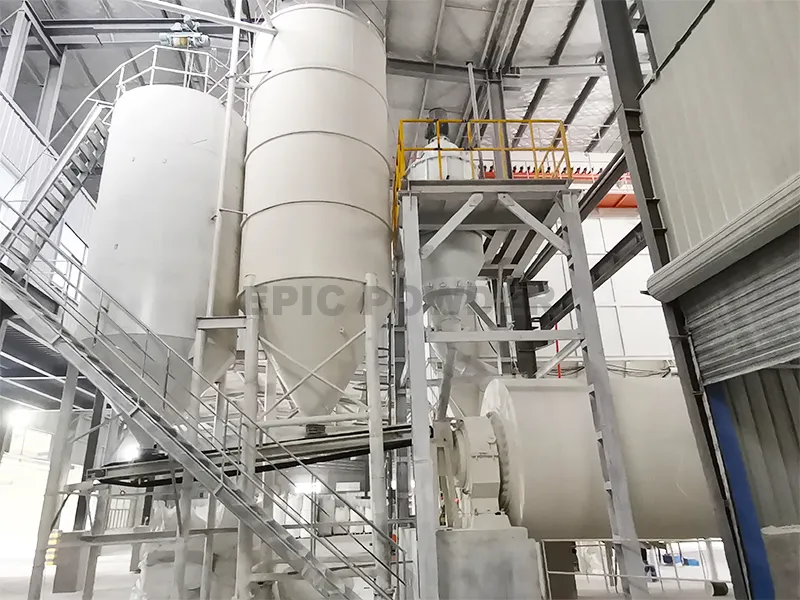
Which Baryte Grinding Process Achieves a Lower D50?
Clear conclusion: Wet ball milling, especially stirred mills or sand mills, is the mainstream and most cost-effective industrial route to achieve the lowest D50.
Reasoning:
- Dispersion State Determines Fineness Limit
In dry milling, baryte fine particles (<2–3 μm) easily agglomerate due to van der Waals forces, static charges, and mechanical interlocking. These agglomerates are treated as “large particles” in subsequent impacts, wasting energy on breaking agglomerates rather than further refining.In wet milling, water as a polar medium significantly reduces particle attraction (via double-layer repulsion and steric hindrance). Grinding/dispersing aids (such as sodium polyacrylate, sodium hexametaphosphate, organosilicon compounds) can control Zeta potential to -40 to -60 mV. Particles remain suspended, directly exposed to grinding media impacts, resulting in higher efficiency and finer particle size limits. - Energy Transfer Efficiency
The density of the wet medium (water) is ~800–1000 times that of air and has much higher viscosity. The energy transfer efficiency in ball–slurry–particle collisions is significantly higher. Literature and industrial practice show that for the same equipment power, wet milling converts more mechanical energy into effective particle fracture energy. - Industrial Data Comparison
- Dry closed-loop ball mill + turbine classifier: D50 is stably controlled at 3.8–5.5 μm, which is excellent. Lowering further drastically increases energy consumption and dust collection load. Few companies can stably achieve D50 <3.5 μm.
- Wet stirred/sand mills (0.6–1.0 mm zirconia beads): D50 1.0–2.0 μm is conventional. High-end configurations (0.2–0.4 mm beads + high linear speed) can achieve D50 0.5–0.8 μm. Some nano sand mills reach D50 <400 nm (though cost is very high).
- Overgrinding and Particle Size Distribution Control
Dry milling of baryte often shows bimodal or multimodal distributions (“too many fines <1 μm, middle range deficient”), with <1 μm fines up to 30–50%. Wet milling combined with proper classification (or multi-stage milling) effectively removes excessive fines. Span values are usually 1.3–1.8, far better than dry milling (2.0–3.0).
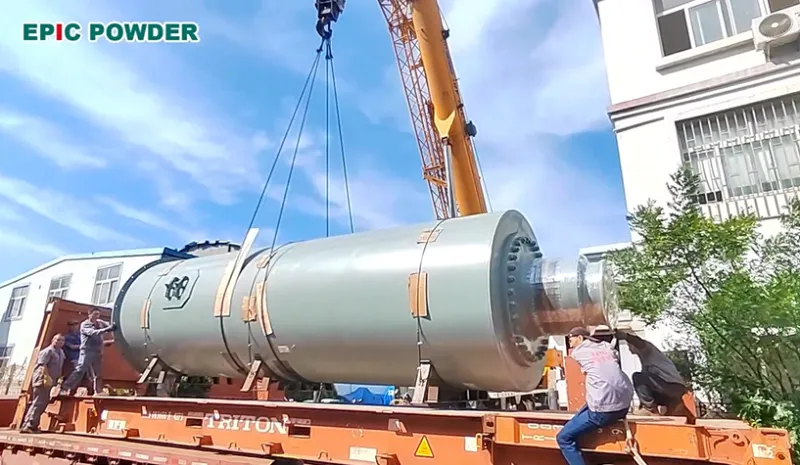
Dry Ball Milling Still Has Irreplaceable Applications
Although wet milling dominates in ultrafine grinding (D50 <3 μm), dry milling remains competitive in the following scenarios:
- Medium-fine powders with D50 5–20 μm (drilling grade, general chemical grade) — low investment, simple system, low operating cost.
- Products extremely sensitive to water (e.g., some surface-modified baryte).
- Small-batch, multi-product, fast-switching production.
- Combination routes: preliminary coarse grinding + dry ball mill + jet mill (can easily achieve D50 1.5–2.5 μm).
Industrial Selection Logic (2026 Perspective)
| Target D50 Range | Recommended Primary Process | Secondary/Alternative | Cost Ranking (Low → High) |
|---|---|---|---|
| >10 μm | Dry ball milling | — | Dry ball milling |
| 5–10 μm | Dry ball mill + classification | Wet ball mill | Dry ball milling |
| 3–5 μm | Wet stirred mill | Dry + jet mill series | Dry combination ≈ Wet |
| 1–3 μm | Wet sand mill/stirred mill | Dry + multi-stage jet mills (expensive) | Wet |
| <1 μm | Wet nano sand mill | Rare dry routes | Wet (high) |
Conclusion
In baryte grinding, the industry consensus is: “the finer, the wetter.”
- To achieve lower D50 (especially <3 μm), wet ball milling (stirred/sand mill) is the most mature, cost-effective industrial solution.
- Dry ball milling is better suited for medium-fine powders, large capacity, low-cost scenarios, or as a preliminary coarse grinding step in ultrafine processes.
- Future trends: with growing demand for high-end coatings, 5G shielding materials, and medical imaging contrast agents, wet ultrafine/nano baryte capacity will continue to expand. Combined dry-wet routes (dry coarse + wet fine) and integrated dry jet milling + surface modification routes are also gaining traction in specific niche markets.
The choice between dry and wet milling ultimately depends on the target D50, particle size distribution requirements, production scale, investment budget, and subsequent modification/drying considerations—not simply on which is “better.”

“Thanks for reading. I hope my article helps. Please leave a comment down below. You may also contact Zelda online customer representative for any further inquiries.”
— Posted by Emily Chen
 English
  العربية
  Español
  Português
  Français
  Türkçe
  Tiếng Việt
  Русский