
Feldspar and kaolin are indispensable non-metallic mineral raw materials widely used in traditional and modern industries such as ceramics, glass, sanitary ware, paper coating, rubber fillers, and refractory materials. Feldspar mainly provides fluxing and skeletal functions, while kaolin is valued for its high whiteness, plasticity, layered structure, and excellent covering ability. Whether it is the sintering behavior of ceramic bodies, glaze gloss, or the brightness and opacity of paper coatings, the final product performance is highly dependent on raw material characteristics—especially particle size distribution (notably D50 and D97), particle morphology, whiteness, and impurity control. Ball mills remain the most mainstream equipment for fine and ultrafine grinding of feldspar and kaolin. However, a long-standing and practical question continues to challenge plant engineers and decision-makers: for the same raw material, should dry ball milling or wet ball milling be selected?
The two processes differ significantly in energy consumption, achievable fineness, particle size distribution uniformity, iron contamination control, downstream processing cost, and environmental pressure—often directly determining return on investment and product competitiveness.
This article provides an objective decision-making reference by analyzing material characteristics, process principles, advantages and disadvantages, and typical application scenarios, while also incorporating recent technological trends.
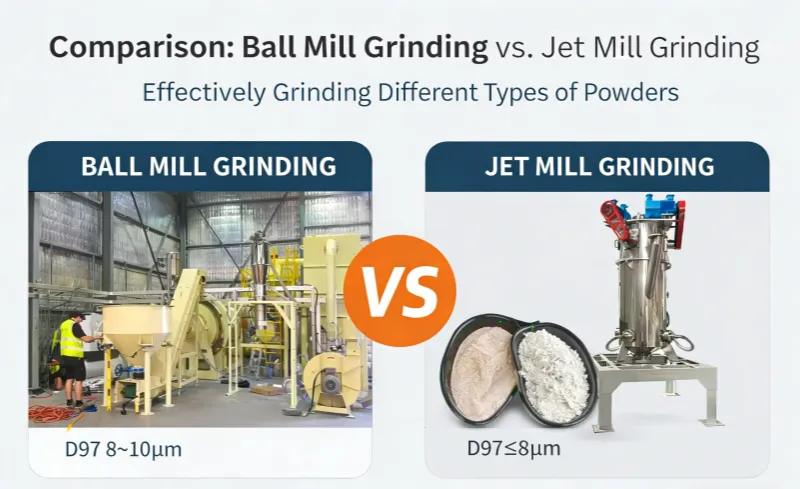
Comparison of Material Characteristics: Feldspar and Kaolin Grinding
Feldspar and kaolin differ substantially in hardness, structure, moisture behavior, and impurity sensitivity, which directly affects the choice of grinding method.
Feldspar (mainly potassium feldspar and sodium feldspar)
- Mohs hardness: 6–6.5
- Brittle, but highly abrasive
- Highly sensitive to iron and titanium impurities (Fe > 0.1–0.3% can noticeably affect ceramic whiteness)
- Typical fineness requirement: −200 to −325 mesh (high-end porcelain may exceed −400 mesh)
- Naturally low moisture content, making dry processing relatively favorable
Kaolin
- Mohs hardness: 2–2.5
- Layered silicate structure
- Naturally high moisture content (10–20% in run-of-mine ore)
- Easily disperses and forms slurry
- High-end applications (paper coating, cosmetics, premium ceramics) require D50 < 2 μm or even < 1 μm, whiteness > 92–94, and +325 mesh residue < 0.005%
- Strong requirements for delamination and dispersion while maintaining plate-like morphology
Summary:
Feldspar grinding focuses on brittle fracture and iron contamination control, whereas kaolin grinding emphasizes delamination, ultrafine dispersion, and preservation of its layered structure. As a result, wet grinding is almost a “natural choice” for kaolin, while feldspar offers greater flexibility.
Compare Dry vs. Wet Ball Mills for Feldspar and Kaolin Grinding
| Parameter | Dry Ball Milling | Wet Ball Milling |
|---|---|---|
| Grinding media | Steel balls / ceramic balls / pebbles | Steel or ceramic balls (often with lining) |
| Media-to-material ratio | High (3:1–5:1) | Lower (2:1–4:1) + water |
| Energy consumption (kWh/t, same fineness) | Higher (baseline) | Typically 15–30% lower |
| Fineness limit | D97 of 5–10 μm is difficult to surpass | Easily D97 of 1–2 μm or even submicron |
| Particle size distribution | Prone to static agglomeration, wide distribution | Good dispersion, narrow and uniform |
| Dust & noise | High, requires strong dust collection | Nearly dust-free |
| Post-processing | Direct dry powder | Requires filtration and drying |
| Iron contamination control | Relies on ceramic lining and media | Easier iron removal via magnetic separation |
| Initial investment | Simple equipment, costly dust system | More complex system, lower unit capacity cost |
| Operating cost | Media + power + dust control | Media + power + drying + wastewater |
Core conclusion:
Wet grinding outperforms dry grinding in energy efficiency, fineness capability, and particle uniformity—but at the cost of additional downstream processing.
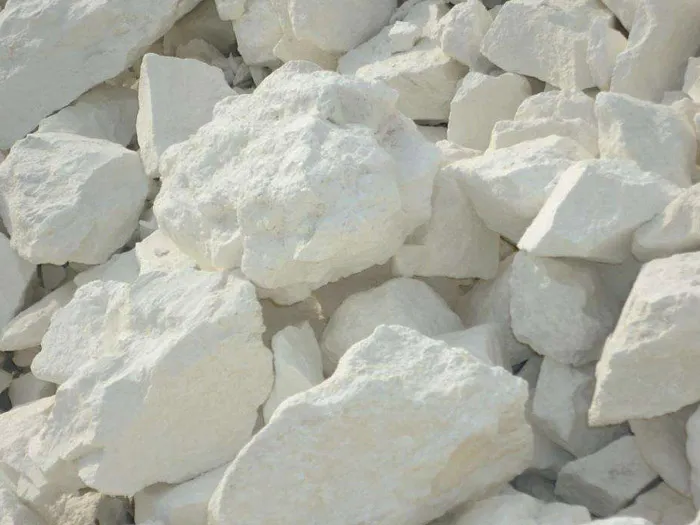
Advantages and Limitations of Dry Ball Milling
Advantages
- Short process flow; no dewatering or drying required
- Direct production of dry powder, ideal for dry-product applications
- With full ceramic lining and ceramic media, iron contamination in feldspar can be well controlled
- Simpler equipment and lower initial investment for small to medium capacities
- Acceptable for low-end kaolin fillers and refractory materials
Limitations
- Lower grinding efficiency; energy consumption typically 15–30% higher
- Limited fineness; kaolin struggles to reach < 2 μm consistently
- Ultrafine dry grinding of feldspar risks over-grinding and amorphization
- Severe static agglomeration and broad particle size distribution
- High dust control costs under increasingly strict environmental regulations
Advantages and Limitations of Wet Ball Milling
Advantages
- Higher grinding efficiency and larger throughput at the same power
- Lower energy consumption (commonly 15–30% savings reported)
- Achieves much finer particle sizes (kaolin D50 < 0.5–1 μm is common)
- Narrow particle size distribution and excellent dispersion
- Superior heat dissipation for long-term continuous operation
- Ideal for kaolin delamination and slurry-based downstream applications
- For feldspar, iron removal is significantly more effective in slurry form
Limitations
- Requires filtration and drying (spray drying or flash drying), increasing capital and energy cost
- Higher media wear and stricter corrosion resistance requirements
- Unsuitable for niche applications requiring absolutely dry final products
Application-Based Decision Guide
Typical Kaolin Applications
- Paper coating, cosmetics, high-end ceramics, pre-treatment for calcined kaolin
→ Strongly recommended: Wet ball milling - Low-end fillers, general rubber/plastic fillers, coarse refractory materials
→ Dry milling may still be acceptable
Typical Feldspar Applications
- High-grade tableware ceramics, tiles, sanitary ware, glass
→ Wet milling has become the mainstream choice - Enamels and electrical ceramics requiring coarse feldspar (around −200 mesh)
→ Dry milling remains common - High-iron feldspar ores with fully ceramic dry systems
→ Still used where iron control is well managed
Hybrid Process
Many large producers adopt a combined route:
Dry coarse grinding (jaw crusher + Raymond/vertical mill) → wet fine grinding, balancing efficiency and cost.
Indicative total cost ranking (varies by electricity, water, and scale):
Wet milling (high fineness) < Wet milling (medium fineness) ≈ Dry milling (coarse) < Dry milling (ultrafine)
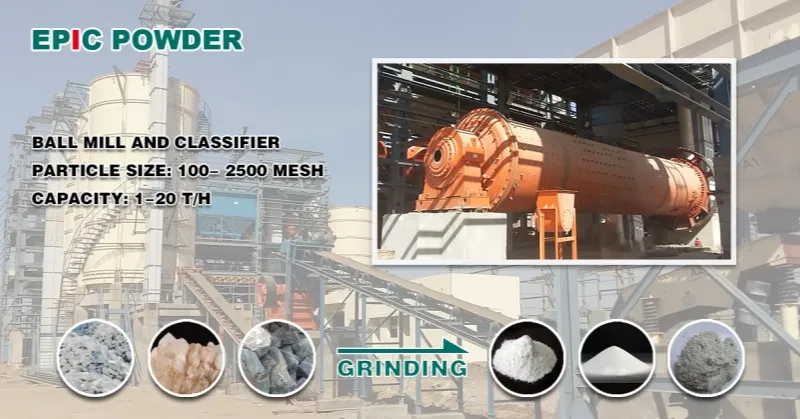
Recent Trends and Technological Advances (as of 2026)
- Dry grinding advancements: Grinding aids, high-efficiency vertical mills with internal classification, and advanced air classification systems now enable D97 < 3–5 μm
- Wet grinding energy reduction: High-efficiency stirred mills, continuous wet systems, ceramic linings with high-purity zirconia media, and heat-pump-assisted spray drying
- Hybrid processes: Increasing adoption of “dry coarse + wet fine + efficient drying” routes
- Environmental drivers: Zero dust emission and zero wastewater discharge requirements are pushing both closed-loop wet systems and ultra-efficient dry dust collection
Conclusions and Recommendations
Considering achievable fineness, particle quality, energy efficiency, and iron removal capability, wet ball milling demonstrates superior overall performance for feldspar and kaolin grinding in most modern industrial applications, especially when target specifications include D50 < 2–5 μm, whiteness > 92, and a tight particle size distribution.
However, “better” is never absolute. Final process selection must consider:
- Target product fineness and quality requirements
- Production scale (wet milling shows clear advantages at ≥10,000 t/a)
- Final product form (dry powder vs. slurry)
- Local water, electricity, labor, and environmental costs
- Raw material moisture and impurity characteristics
Strong recommendation:
Before final equipment selection, conduct laboratory tests (stirred mill) followed by pilot-scale continuous trials to obtain real data on energy consumption, media wear, and product quality—rather than relying solely on theoretical calculations or supplier claims.
Choosing between dry and wet ball milling is a critical step in balancing product quality, total cost, and environmental compliance. In 2026, this decision often determines a company’s long-term competitiveness in an increasingly demanding market.

“Thanks for reading. I hope my article helps. Please leave a comment down below. You may also contact Zelda online customer representative for any further inquiries.”
— Posted by Emily Chen
 English
  العربية
  Español
  Português
  Français
  Türkçe
  Tiếng Việt
  Русский