
The Challenge of Processing Granite into Ultrafine Powder: Material Hardness & Abrasiveness and Ultrafine Definition
Grinding granite into ultrafine powder is no simple feat. Granite is a hard, abrasive material, typically rated around 6 to 7 on the Mohs hardness scale, making it tough on grinding equipment. Its high quartz and feldspar content increase wear on grinding media and liners, demanding robust, wear-resistant technology for efficient processing.
When we talk about ultrafine grinding, we mean reducing the particle size of granite powder well below 10 microns, often targeting a D97 particle size under 10 µm for advanced applications like high-performance concrete, specialized coatings, or mineral fillers. Achieving such a fine particle size demands precise control over the grinding process, including dry grinding circuits with efficient ultrafine air classifiers to separate the desired powder fractions.
The key challenge lies in balancing material hardness and abrasiveness with the grinding system’s capability to deliver consistent mineral processing efficiency. High specific energy consumption (kWh/t) is often unavoidable, but optimizing the process can reduce energy costs and improve product quality. This is why choosing the right grinding system—whether a ball mill or a vertical roller mill—and integrating it with advanced classification technology is critical.
At Epic Powder, we understand the unique difficulties of granite powder processing and provide tailored solutions that address wear rate concerns, particle size distribution (PSD), and the need for ultrafine grinding, helping customers achieve optimal results with efficiency and reliability.
Contender 1: The Ball Mill System (with Air Classification)
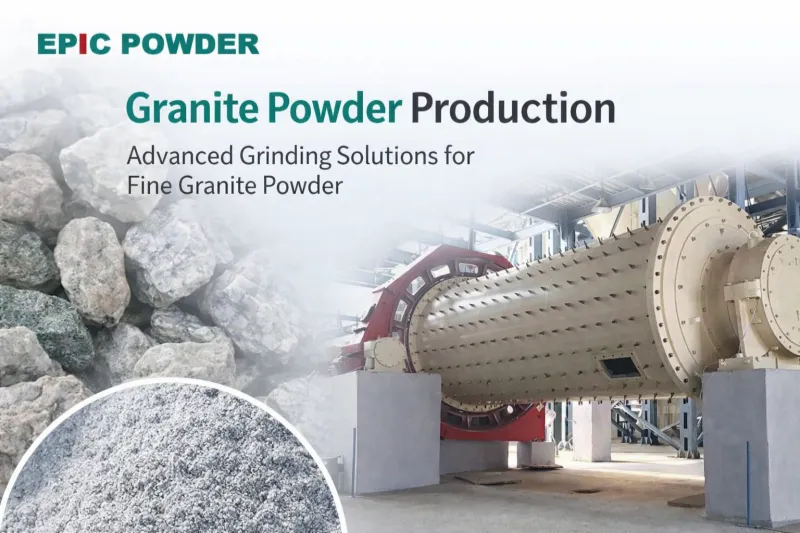
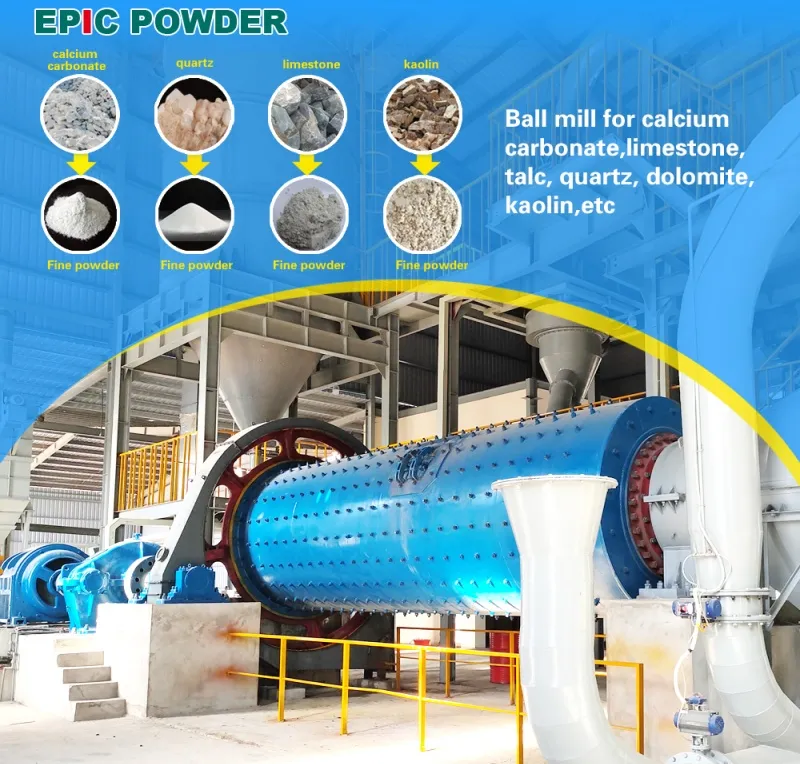
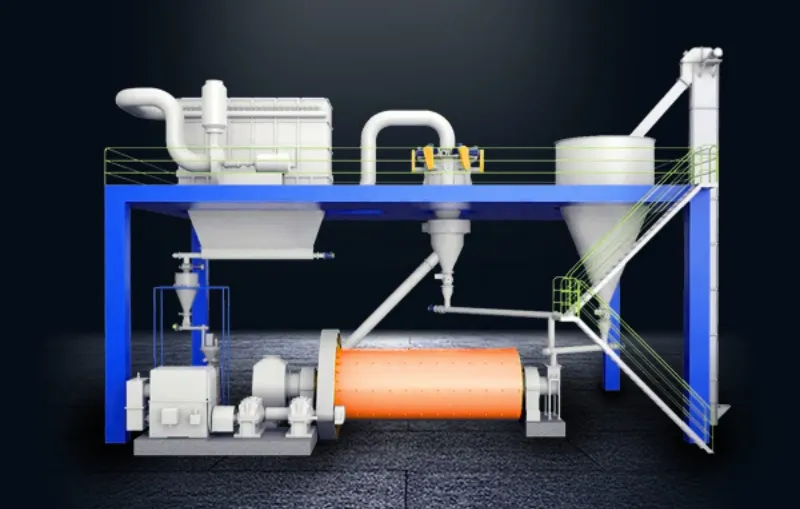
Ball mills remain a popular choice for ultrafine granite powder processing due to their proven grinding principle and versatility. The system works by rotating a cylinder filled with grinding media—usually steel or ceramic balls—that crush the granite through impact and attrition. After grinding, an ultrafine air classifier separates the desired fine particles from coarser material, ensuring precise control over the particle size distribution (PSD) and the final D97 particle size, critical for quality granite powders.
For granite, which rates high on the Mohs hardness scale and is notably abrasive, ball mills offer reliable performance. They excel at reducing the material to ultrafine sizes, often below 10 microns, suiting applications that demand highly refined granite powder. Additionally, air classification enables flexible adjustment of cut points, making this system adaptable to different ultrafine targets.
Pros for Granite Grinding:
- Effective grinding of hard, abrasive granite thanks to heavy impact and inter-particle crushing.
- High control over ultrafine powder output through integrated air classifiers.
- Compatible with dry grinding circuits, minimizing moisture-related issues.
- Proven technology with readily available maintenance and supporting parts.
Cons for Granite Grinding:
- Higher specific energy consumption (kWh/t) compared to some competing technologies.
- Grinding media wear rates can be significant, increasing operational costs due to frequent replacement of ball mill liners and media.
- Larger system footprint and more complex installation.
- Requires regular maintenance to manage wear and maintain classifier efficiency.
If you want to explore how ball mills serve other tough minerals, check out the detailed examples of limestone ball mills for efficient industrial grinding or learn why these systems are preferred for zircon sand processing in ball mill zircon sand applications.
Overall, ball mill systems with advanced air classification remain a strong candidate where consistent ultrafine granite powder quality and adaptability are priorities.
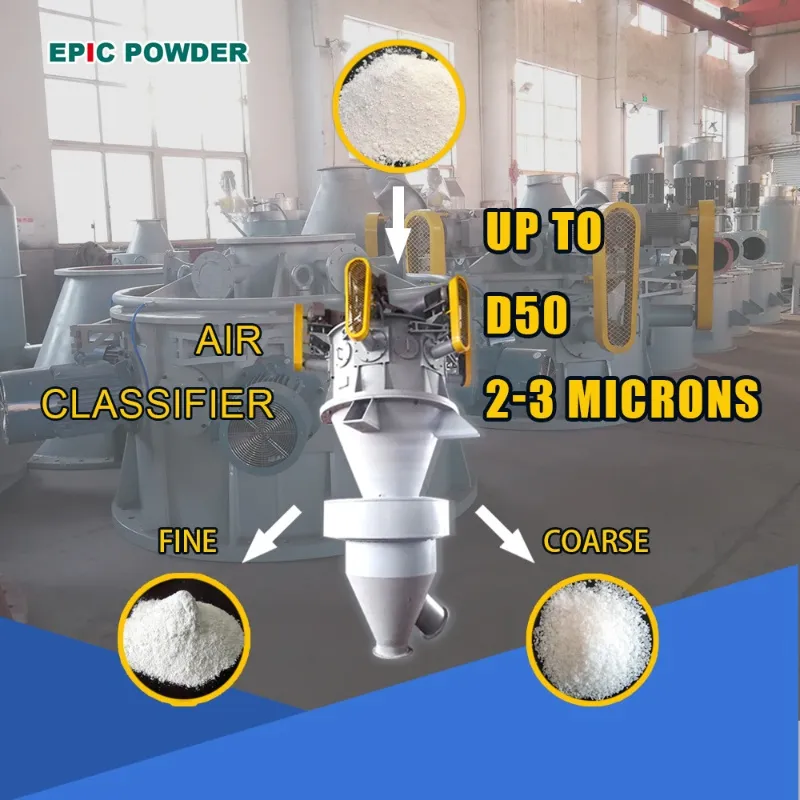
Contender 2: The Vertical Roller Mill (VRM)
The Vertical Roller Mill (VRM) is a popular choice for granite ultrafine grinding, thanks to its unique grinding mechanism and built-in classification system. Unlike ball mills that rely on tumbling grinding media, a VRM crushes granite by applying pressure between a rotating grinding table and multiple vertical rollers. This inter-particle crushing combined with the rollers’ grinding action creates a more efficient grinding process tailored for abrasive materials like granite, known for its high Mohs hardness scale rating.
One standout feature of the VRM is its integrated ultrafine air classifier. This allows the mill to separate fine particles directly inside the system, ensuring consistent particle size distribution (PSD) with a sharp D97 particle size cut-off. The system can maintain tight control over product quality while minimizing overgrinding, which is crucial in granite powder processing for ultrafine applications.
Pros of VRM for Granite Grinding:
- Energy Efficiency: VRMs typically have lower specific energy consumption (kWh/t) compared to ball mills due to reduced impact energy and better grinding pressure control.
- Compact System: Integrated classification means a smaller footprint and less complex system design.
- Longer Wear Parts Life: Vertical mill roller tires and grinding tables are designed for wear resistance, potentially lowering grinding media wear rates and maintenance costs.
- Dry Grinding Friendly: VRMs excel in dry grinding circuits, which is often preferred in granite processing to minimize clumping and improve downstream handling.
Cons of VRM for Granite Grinding:
- Complex Maintenance: Despite wear-resistant parts, maintaining the rollers and table can require specialized skills and careful scheduling.
- Initial Cost: The upfront investment in a VRM, especially with advanced integrated ultrafine air classifiers, can be higher than traditional ball mill systems.
- Limited Flexibility: VRMs can be less flexible in handling changing feed sizes or moisture content variations compared to ball mills.
In sum, the Vertical Roller Mill offers a highly efficient, integrated solution for ultrafine granite grinding, especially suited for operations focused on energy savings and system compactness. For deeper insight into how integrated classification enhances ultrafine powder production, see our detailed overview of ceramic powder processing with specialized classification systems.
Head-to-Head Comparison: Performance Metrics
When comparing ball mills with air classification to vertical roller mills (VRM) for granite ultrafine grinding, several key performance metrics come into play, including energy use, wear and maintenance, particle size distribution, and system footprint.
| Metric | Ball Mill with Air Classifier | Vertical Roller Mill (VRM) |
|---|---|---|
| Energy Efficiency | Moderate; high specific energy consumption (kWh/t) due to longer grinding times | High; VRMs use less power by grinding and classifying in one unit |
| Wear Parts & Maintenance | Frequent replacement of grinding media and liners (ball mill liner lifespan is limited) | Lower wear with roller tires; fewer consumables, but rollers and table still require monitoring |
| Particle Size Distribution | Reliable ultrafine control via dedicated ultrafine air classifiers with narrow D97 PSD | Integrated classifier provides consistent PSD but may struggle with very hard granite |
| Product Quality | Excellent for fine and ultrafine granite powder with minimal overgrinding | High-quality output, but sometimes less uniform in extreme fineness |
| System Integration & Footprint | Larger footprint with separate grinding and classification units; higher installation complexity | Compact, integrated system ideal for limited space and streamlined operation |
Energy Efficiency & Power Consumption
VRMs tend to be more energy-efficient by combining grinding and classification, typically reducing specific energy consumption (kWh/t). Ball mills with air classifiers require extra power for the classifier and longer grinding periods, increasing overall consumption.
Wear Parts & Maintenance Costs
Granite’s high Mohs hardness and abrasive nature accelerate wear. Ball mills demand frequent liner and grinding media replacement, adding to downtime and costs. VRMs reduce wear parts but involve roller tire and table maintenance, which can be costly but less frequent.
Particle Size Distribution & Product Quality
The ultrafine air classifier linked with ball mills excels at producing a tight particle size distribution (PSD), critical for applications needing precise D97 particle size. VRMs bundle classification inside but can face challenges in handling abrasive granite for ultrafine specs.
System Integration & Footprint
Ball mill systems are bulkier and require more space due to separate classifier units. VRMs offer an all-in-one compact setup, reducing footprint and installation complexity — a plus in dense industrial sites.
For an in-depth look at the benefits of ultrafine air classification, explore Epic Powder’s range of advanced ultrafine air classifiers, designed to optimize particle size control and energy efficiency in grinding circuits.
In , the choice depends on balancing energy use, wear costs, and product quality demands against site constraints and maintenance capabilities.
The Decision Matrix: When to Choose Which?
Choosing between the Ball Mill with Air Classification and the Vertical Roller Mill (VRM) for granite ultrafine grinding depends on several key factors. Both have their strengths, but the decision boils down to your specific needs around material characteristics, energy use, maintenance, and product quality.
Criteria Favoring Ball Mill Classification Line
- Material Hardness & Abrasiveness: Ball mills handle highly abrasive granite well, with ceramic grinding media reducing wear rates effectively.
- Product Fineness: If you need extremely fine powders (D97 particle size below 10 microns), ball mills combined with ultrafine air classifiers deliver consistent results.
- Flexibility: Ball mill systems are versatile for adjusting PSD (Particle Size Distribution) and easily integrate with dry grinding circuits.
- Footprint Constraints: While typically larger, ball mill setups are well-suited for facilities with fewer space constraints.
- Maintenance Accessibility: Ball mill liners and grinding media wear are predictable, and replacement cycles are well-established, helping keep downtime manageable.
Criteria Favoring Vertical Roller Mill (VRM)
- Energy Efficiency: VRMs consume less specific energy consumption (kWh/t), making them greener and cheaper to run long term.
- Space Saving & Integration: VRMs offer a smaller footprint by combining grinding and classification in one unit, ideal for compact plants.
- Maintenance Costs: VRM roller tires and wear parts last long on granite, lowering maintenance frequency and costs.
- Consistent Particle Shape: VRMs promote inter-particle crushing, producing more uniform powder fines beneficial in mineral processing efficiency.
- Dry Grinding Optimization: When paired with high-pressure grinding rolls (HPGR), VRMs shine in dry granite powder processing.
| Decision Factor | Ball Mill with Air Classifier | Vertical Roller Mill (VRM) |
|---|---|---|
| Abrasive Material Grinding | Excellent, ceramic media available | Good, rollers durable on granite |
| Ultrafine Particle Size (D97) | Below 10 µm achievable | Around 10-15 µm typical |
| Specific Energy Consumption | Higher kWh/t | Lower kWh/t |
| Maintenance Costs | Moderate, predictable wear | Lower, longer lifespan parts |
| System Footprint | Larger | Compact |
| Product PSD Control | Flexible with air classifiers | Integrated, efficient classification |
| Integration with Dry Circuits | Well-established | Best when combined with HPGR |
In , choose the Ball Mill Classification Line when ultrafine particle size and flexibility are top priorities despite higher energy use and maintenance. Opt for the Vertical Roller Mill when energy efficiency, footprint, and lower running costs matter more, especially if you aim for a consistent, slightly coarser granite powder.
For those needing to understand more about the enduring role of ball mills in mineral processing and how they fit into industrial grinding circuits, check out this detailed overview of the irreplaceable role of ball mills in mining operations.
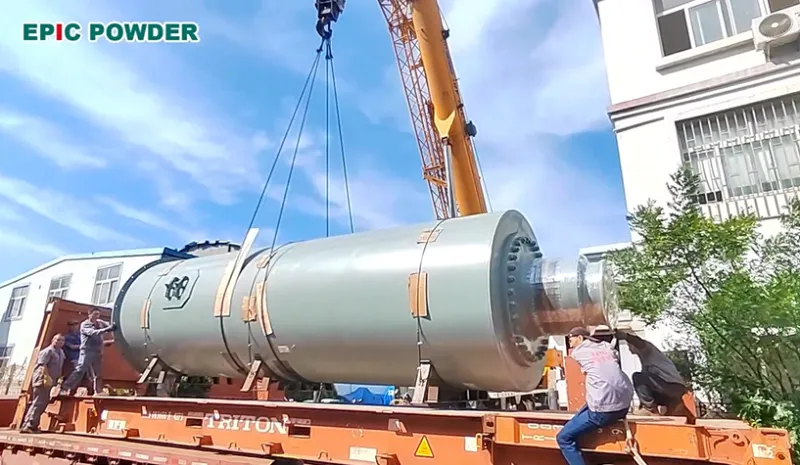
How Epic Powder Optimizes Granite Grinding
Epic Powder takes granite powder processing to the next level by offering customized system solutions tailored to the unique challenges of ultrafine grinding hard and abrasive materials like granite. Understanding granite’s high Mohs hardness scale and abrasive nature, Epic Powder designs grinding circuits that balance efficiency with durability.
One standout approach is their hybrid grinding system, which combines traditional ball mill classification lines with advanced ultrafine air classifiers. This blend improves mineral processing efficiency by ensuring precise particle size distribution (PSD), particularly targeting a consistent D97 particle size for high-quality granite powder. This system reduces specific energy consumption (kWh/t) while maintaining excellent pulverization, making it a perfect match for dry grinding circuits demanding ultrafine results. For more insights on enhancing grinding efficiency, Epic Powder integrates elements from proven ball mill and classification production lines.
Moreover, Epic Powder extensively employs wear-resistant technology. They use high-quality wear parts like ceramic grinding media and reinforced liners that significantly extend ball mill liner lifespan and vertical mill roller tires durability. This focus on reducing grinding media wear rates and part replacement frequency not only lowers maintenance costs but also keeps downtime minimal.
By offering these innovative, durable, and energy-efficient solutions, Epic Powder helps customers worldwide maximize ultrafine granite grinding performance while controlling operational costs effectively.

“Thanks for reading. I hope my article helps. Please leave a comment down below. You may also contact Zelda online customer representative for any further inquiries.”
— Posted by Emily Chen
 English
  العربية
  Español
  Português
  Français
  Türkçe
  Tiếng Việt
  Русский