
The ball mill is operating normally, but its specific output remains low. The current is too high, and steel ball consumption is still high—the root cause of many of these issues lies in the ball loading ratio. The ball loading ratio is the percentage of the mill’s effective volume occupied by steel balls. It determines the balls’ trajectory, impact energy, and grinding area. If the loading is too high, the mill becomes “choked”; if too low, the steel balls “hit empty space.” A difference of just 5 percentage points in the loading rate can result in a 15%–20% difference in mill efficiency.
Why Is the Ball Filling Rate So Important in Ball Mill Operation?
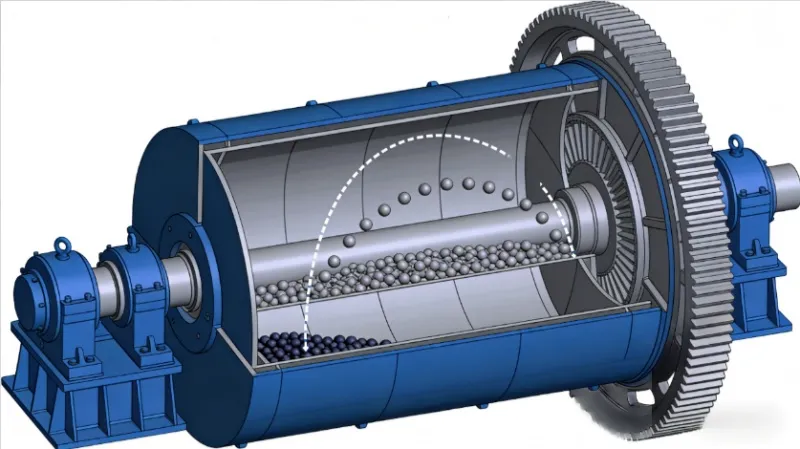
The working principle of a ball mill is that steel balls are lifted under the combined action of centrifugal force and gravity, then fall to impact and grind the ore. The ball filling rate directly affects three key parameters:
Steel Ball Drop Height
When the ball charge is appropriate, the steel balls follow a parabolic trajectory after being lifted to the correct height. The impact energy is concentrated on the ore. If the ball charge is too high, the steel balls accumulate at the bottom of the mill. The lifting height decreases, and the impact force diminishes. If the ball charge is too low, although the drop height is high, the number of balls is insufficient, resulting in fewer impacts per unit of time.
Steel Ball Motion States:
The motion of steel balls inside a grinding mill can be categorized into three states: cascading, tumbling, and centrifugal. With a ball charge below 30%, the balls primarily cascade, resulting in weak grinding action. When the ball charge is 30%–45%, tumbling and cascading coexist, creating a balance between impact and grinding. When the ball charge is >45%, the balls pile up, tumbling is impeded, and grinding efficiency decreases.
Effective Power of the Ball Mill:
The power of the ball mill first increases and then decreases as the ball charge increases. The ball charge corresponding to the peak point is the optimal value. Empirical formula: Optimal ball charge = 0.7–0.8 × (steel ball filling rate). For grid-type ball mills, this is typically set at 40%–45%; for overflow-type ball mills, it is set at 35%–40%.
What Is the Recommended Ball Filling Rate for Different Types of Ball Mills?
Grate-type ball mill: Fast discharge rate, less prone to slurry buildup, and can accommodate a higher ball loading ratio. Recommended range: 40%–45%. The grate plate forces the discharge, ensuring the slurry is discharged promptly even with a slightly higher ball loading ratio. Steel balls are not excessively enveloped by the slurry.
Overflow-type ball mills: Discharge relies on the natural flow of the slurry. If the ball loading rate is too high, the slurry cannot be discharged, leading to a risk of slurry buildup. A ball loading rate of 35%–40% is recommended. Overflow-type mills are sensitive to ball loading rates; efficiency actually decreases when the rate exceeds 40%.
Conical ball mills: These fall between the two types; a ball loading rate of 38%–42% is recommended.
Rod mills: Since steel rods differ from steel balls, the rod loading rate is typically 35%–40%; if too high, rod entanglement is likely to occur.
Fine grinding mills (re-grinding): Since the feed particle size is already relatively fine, the ball loading rate can be appropriately reduced to 30%–35%. Grinding is the primary process, with impact action serving as a secondary function.
What Happens If the Ball Filling Rate Is Too High?
Abnormal mill current:
When the ball loading rate exceeds 45%, the mill’s starting current rises sharply, while the operating current actually decreases. This is because the accumulation of steel balls reduces the drop height, thereby decreasing the motor load. This is not energy savings; it means the steel balls are not doing their job.
Muffled mill noise:
A normal mill produces a crisp sound of steel balls colliding. When overloaded, the steel balls cushion each other, and the impact sound becomes a low, muffled “hum,” as if the mill were covered with a quilt.
Decreased grinding efficiency:
Steel balls accumulate at the bottom of the cylinder, reducing the effective drop height and diminishing impact energy. At the same time, the gaps between the steel balls narrow, making it difficult for the slurry to pass through. As a result, the material remains in the mill for too long, leading to severe overgrinding.
Coarser discharge particle size:
Although over-grinding is severe, coarse particles are not ground finely due to insufficient impact energy. The proportion of particles finer than -200 mesh in the discharge decreases, while the proportion of coarse particles increases.
Increased liner wear:
Steel balls accumulate at the bottom, increasing sliding friction. Wear on the shell liners and end cap liners accelerates. In particular, grate plates are prone to cracking from impacts by steel balls.
Wasted energy consumption:
Motor output power is used to overcome friction between steel balls rather than to crush ore. Electricity consumption per ton of ore increases by 15%–25%.
Actual Measurement Data:
At a certain iron ore mill, the ball loading rate of a grate-type ball mill was increased from 42% to 48%. The mill current decreased from 320A to 280A, and the throughput per unit decreased from 105 tons/hour to 85 tons/hour. Electricity consumption per ton of ore rose from 18 kWh to 24 kWh.

What Happens If the Ball Filling Rate Is Too Low?
High impact energy but low frequency of ball drops:
When the ball charge is below 30%, although the drop height of the steel balls is high, their quantity is insufficient. The number of impacts per unit time is low. Coarse particle crushing efficiency is low, and the discharge particle size is coarse.
Insufficient grinding surface area:
The grinding surface area between steel balls and between steel balls and the liner is directly proportional to the ball charge ratio. A low ball charge ratio results in insufficient fine grinding capacity, and the -200 mesh content fails to meet requirements.
Exposed liners and accelerated wear:
With fewer steel balls, the slurry and steel balls directly erode the liners, intensifying wear. Simultaneously, steel balls directly impact the exposed liners, causing pitting and fractures.
Excessively high mill current:
When the ball loading rate is too low, the steel balls fall from a greater height, placing a heavy load on the motor and causing the current reading to rise. However, the grinding is not fine—the high current is a false indication.
Decreased mill efficiency:
Processing capacity is low because the mill’s capacity is not fully utilized. Increasing the feed rate will immediately result in coarser discharge.
How Can Operators Determine Whether the Ball Filling Rate Is Appropriate?
Listening Method
Normal: A rhythmic “clang-clang” impact sound that is crisp and not muffled.
Excessive ball loading: The sound is muffled, low-pitched, and continuous without rhythm.
Insufficient ball loading: The sound is crisp but sparse, with a hollow sensation, and the steel balls strike the liner directly.
Current Measurement Method
Record the mill’s no-load current I0 (when there is no slurry or steel balls). The normal load current should be I0 × 1.3–1.5. If the current is significantly higher than this value, the ball charge may be too low (steel balls are being thrown too high). If the current is significantly lower than this value, the ball charge may be too high (steel balls are not being thrown high enough).
Ball Consumption Measurement Method
Calculate the monthly amount of steel balls added and determine ball consumption based on the mill’s throughput.
Normal ball consumption: 0.5–1.5 kg/t of ore. Abnormally high ball consumption may indicate that the ball loading rate is too high (causing steel balls to wear against each other) or too low (accelerating liner wear).
Observe the discharge
Coarse discharge particle size and high mill current → Ball loading may be too low.
Coarse discharge particle size and low mill current → Ball loading may be too high.
Fine discharge particle size but low mill efficiency → Severe overgrinding; ball loading may be too high.
Shutdown Inspection Method
After shutdown, open the mill manhole and observe the height of the steel balls above the slurry surface. The top of the steel ball pile should protrude 100–200 mm above the slurry surface. If completely submerged → ball loading ratio is too high; if protruding too much (>300 mm) → ball loading ratio is too low.
Measure the distance from the top of the steel ball pile to the center of the mill using a steel ruler to estimate the ball loading ratio.
Conclusion
The ball filling rate is not a parameter where “more is better.”
For most applications:
- Grate Ball Mill: 40%–45%
- Overflow Ball Mill: 35%–40%
Operators should routinely:
- Listen to mill sound
- Monitor motor current
- Track steel ball consumption
- Inspect the mill during shutdowns
- Remove broken balls quarterly
- Replenish new grinding media to maintain proper media grading
Maintaining the correct ball filling rate is one of the most effective ways to achieve stable operation, higher throughput, lower energy consumption, and maximum grinding efficiency.

“Thanks for reading. I hope my article helps. Please leave a comment down below. You may also contact Zelda online customer representative for any further inquiries.”
— Posted by Emily Chen
 English
  العربية
  Español
  Português
  Français
  Türkçe
  Tiếng Việt
  Русский