
In the preparation of ceramic powders, ball mill technology has become one of the core processes for controlling grain size and optimizing microstructure. This is due to its advantages such as simple operation, controllable cost, and strong scalability. During the ball milling process, the synergistic effects of mechanical forces and energy fields run throughout. These effects systematically modify the grain size and structural characteristics of ceramic powders across three key dimensions: physical crushing, lattice distortion, and interfacial diffusion. This lays a solid foundation for improving sintering performance and functional properties of ceramic materials.
Taking the Mo–Tm₂O₃ ceramic system as an example, after 96 hours of ball milling, molybdenum grains can be refined from the original micron scale down to 8 nm. Meanwhile, the lattice constant increases from 0.314 nm to 0.31564 nm. This phenomenon—grain refinement accompanied by lattice expansion—is common in mechanically alloyed ceramic powders. It is also a typical feature of microstructural evolution under ball milling.
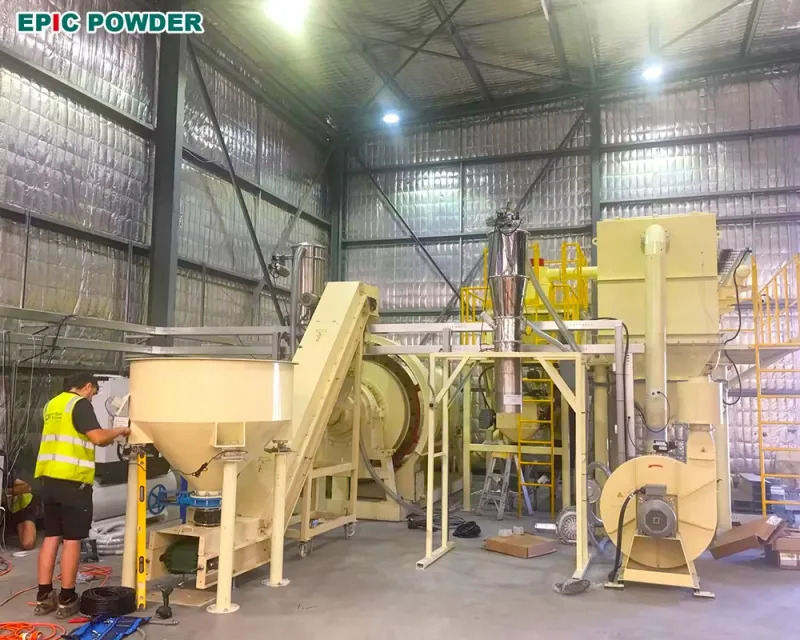
1. Core Mechanisms and Key Parameters of Ball Mill in Ceramic Powders Control
The regulation of ceramic powders by ball milling is essentially the process of transferring and transforming mechanical energy into the material. Through the combined action of multiple mechanisms, precise control of grain size can be achieved. Key parameters such as ball-to-powder ratio, rotational speed, and grinding media directly determine the effectiveness of this control.
1.1 Mechanical Crushing Effect: The Direct Driving Force for Grain Refinement
Mechanical crushing is the primary pathway for grain refinement during ball milling. Its core principle lies in the impact, shear, and compression between grinding balls, as well as between the balls and the inner wall of the mill. These forces directly break the original grain structure of ceramic powders, enabling stepwise refinement.
Under high-energy ball milling conditions, this effect becomes more pronounced. For example, when Mg₂TiO₄ ceramic powder is processed using high-energy ball milling, the particle size can be reduced from the micron scale to 163 nm after 30 hours. Compared with traditional solid-state synthesis, the synthesis temperature can be reduced by 200 °C, enabling the successful preparation of single-phase Mg₂TiO₄ powder.
In practical production, the ball-to-powder ratio and rotational speed are the key factors determining crushing efficiency. For instance, a ratio of 30:1 and a speed of 800 r/min can achieve optimal results. The material of the grinding media also directly affects the limit of grain refinement. Zirconia beads (Mohs hardness 9) provide 20%–30% higher grinding efficiency than zircon silicate beads. Using zirconia beads with a size of 0.1–0.5 mm enables precise grinding of ceramic powders to the nanoscale (<100 nm).
1.2 Lattice Distortion and Energy Storage: Enhancing Sintering Activity
Continuous ball milling not only breaks grains but also introduces a high density of dislocations, lattice defects, and lattice strain into the powder. This creates a stored energy state within the material. This stored energy effectively reduces the activation energy required during subsequent sintering, thereby facilitating densification. Different ball milling methods produce significantly different levels of lattice distortion. For example, plasma-assisted ball mill (PBM) can induce a lattice strain of 0.37% in AlN ceramic powder within 4 hours. In contrast, traditional ball milling (TBM) achieves only 0.32% strain after 6 hours.
The advantages of lattice distortion become especially evident in subsequent processing. For instance, after 3 hours of PBM treatment, the carburization temperature of W–C mixed ceramic powders can be reduced from 1600 °C to 1100 °C. This significantly lowers energy consumption and improves reaction completeness. It is closely related to the mechanical activation effect of milling, which reduces the activation energy for phase transformation and reactions.
1.3 Interfacial Diffusion and Solid Solution: Improving Compositional Uniformity
The mechanochemical effects generated during ball milling can break diffusion barriers. This promotes interfacial diffusion and solid solution formation among different components in ceramic powders. As a result, a uniform solid solution or mixed system is formed, improving compositional homogeneity and overall performance.
For example, in the Mo–Tm₂O₃ system, achieving complete solid solution of Tm₂O₃ in the Mo matrix requires 96 hours of continuous ball milling. This eventually forms a supersaturated solid solution Mo(Tm,O). To further enhance diffusion and mixing efficiency, plasma-assisted ball milling has been widely applied. Through the “thermal explosion–quenching” effect (with electron temperatures up to 10⁴ K), mixing time can be significantly reduced.
For example, in the preparation of high-entropy ceramic powders, uniform mixing can be achieved in just 3 hours. The particle size distribution concentration is improved by 40% compared to traditional ball milling. This reflects the advantages of plasma-assisted milling in improving grinding efficiency and promoting component diffusion.
2. Regulation Laws of Ball Mill Process Parameters

Scientific control of ball mill parameters is key to achieving precise grain size control in ceramic powders. By optimizing milling time, energy field coupling, and media matching according to material characteristics, desired powder properties can be obtained. This also helps avoid problems such as agglomeration and over-grinding.
2.1 Time Window Control: Avoiding Agglomeration and Over-Grinding
The relationship between milling time and particle size shows a staged evolution. Within a reasonable time range, particle size decreases as milling time increases. However, beyond a critical time, cold welding between particles leads to agglomeration, causing particle size to increase instead.
For example, in MgO ceramic powder, particle size decreases from 425 nm to 114 nm after 25 hours of milling. However, when milling exceeds 30 hours, cold welding intensifies and agglomeration becomes significant. This negatively affects powder performance. This behavior is consistent with the general rule of mechanical milling for nanopowder preparation, where the later stage tends toward homogenization and shaping. Excessive milling leads to agglomeration.
2.2 Energy Field Synergy: Improving Grinding Efficiency
The efficiency of single mechanical ball milling is limited. By introducing multi-energy field coupling, grinding efficiency and quality can be significantly improved. For example, using DBD plasma-assisted ball mill to process TiO₂ ceramic powders, an average grain size of 15 nm can be achieved in just 7 hours. This is three times more efficient than conventional ball milling. This improvement is due to the synergistic effect of thermal stress from plasma and mechanical force. These combined effects accelerate grain fragmentation and element diffusion, enhancing mechanical activation.
2.3 Media Matching: Adapting to Different Powder Properties
The parameters of grinding media must match the characteristics of the ceramic powder. This is especially important in plasma-assisted ball milling, where plasma voltage must be selected according to the dielectric constant of the material. For high dielectric constant materials such as TiO₂, a plasma voltage of 22 kV is sufficient. For low dielectric materials such as ZnO, the voltage needs to be increased to 25 kV to enhance electron impact effects and ensure effective grain refinement.
3. Application Limits and Challenges of Ball Milling
Although ball milling has significant advantages in regulating ceramic powders, challenges arise as grain size approaches the nanoscale or even sub-nanoscale. These challenges mainly include abnormal grain growth and over-grinding. When grain size drops below 10 nm, surface energy increases sharply. During subsequent sintering, abnormal grain growth is likely to occur, which destabilizes the nanostructure. For example, in nano-ZrO₂ powders, adding 5% MgO as a grain boundary “pinning” agent can effectively suppress grain growth. Even under high-temperature sintering at 1523 K, the nanoscale grain structure can be maintained. On the other hand, over-grinding may lead to uncontrolled powder properties. For example, in ceramic powders for lithium batteries, when particle size is reduced below 2 μm, interfacial reactions may become unstable.
This negatively affects electrochemical performance. To address this issue, graded ball milling processes can be used. For instance, gradually reducing ball size from 20 mm to 6 mm allows precise control of particle size distribution and prevents over-grinding. This approach is consistent with optimization strategies for ball-milled powders used in lithium battery separators, where parameter control helps avoid performance degradation.
4. Conclusion
The core value of ball milling lies in the coupling of mechanical and chemical energy. This enables reconstruction of the “defect–diffusion–phase transformation” pathways of ceramic powders at the nanoscale. As a result, precise grain size control and performance optimization can be achieved. Ball mill remains a key technology for large-scale preparation of ceramic powders. However, traditional ball milling still faces bottlenecks such as long processing times and high energy consumption. Future development will focus on multi-physics field coupling, such as plasma combined with ultrasonic or magnetic field-assisted ball milling. Through the synergy of multiple energy fields, it will be possible to overcome the limitations of conventional mechanical alloying. This will enable controllable preparation of sub-10 nm ceramic powders. At the same time, further optimization of process parameters will reduce energy consumption and promote wider application of ball milling technology in advanced ceramics and new energy materials.

“Thanks for reading. I hope my article helps. Please leave a comment down below. You may also contact Zelda online customer representative for any further inquiries.”
— Posted by Emily Chen
 English
  العربية
  Español
  Português
  Français
  Türkçe
  Tiếng Việt
  Русский