
Calcite is the primary raw material for ground calcium carbonate (GCC). It is widely used in plastics, coatings, papermaking, rubber, and other industries. In recent years, downstream applications have placed higher demands on powder fineness, particle size distribution, and purity. As a result, ultrafine grinding of calcite has become a key focus in industrial production.
Traditional grinding equipment, such as Raymond mills, can no longer meet the requirements of large-scale and high-precision processing. In contrast, the combined process of a ball mill and an air classifier—commonly known as a ball mill–classifier system—has gradually become a mainstream solution. This article analyzes the technical characteristics, advantages, and limitations of this process. It also evaluates whether it can be regarded as an optimal solution for large-scale industrial calcite production.
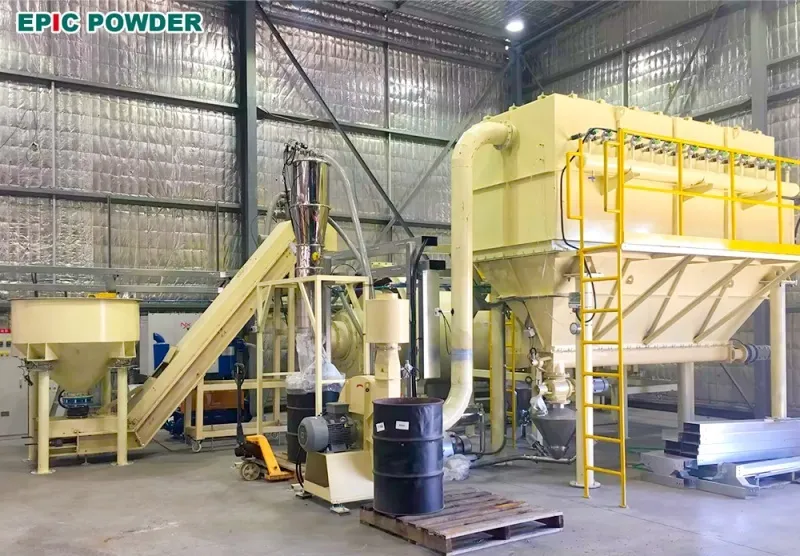
Overview of the Ball Mill–Air Classifier Combined Process
A ball mill is a classic mechanical impact grinding device. It reduces particle size through impact, grinding, and shearing by steel ball media. When operated alone, a ball mill often causes overgrinding. It also produces a wide particle size distribution. Achieving ultrafine products is therefore difficult. To overcome these limitations, modern processes combine the ball mill with an air classifier to form a closed-circuit system.
Typical process flow:
- Crushed ultrafine calcite feed enters the ball mill for grinding;
- The ground material is conveyed by airflow to the air classifier, where centrifugal force generated by the classifier rotor separates qualified fine powder for collection, while coarse particles are returned to the ball mill for further grinding;
- Multiple classifiers can be arranged in parallel or in series to enable simultaneous production of different product specifications.
This system can stably produce ultrafine GCC powders with D97 ranging from 5 to 45 μm, achieving fineness above 2500 mesh, and is suitable for dry processing.
Process Advantages: Why Is It Suitable for Large-Scale Industrial Ultrafine Calcite Grinding?
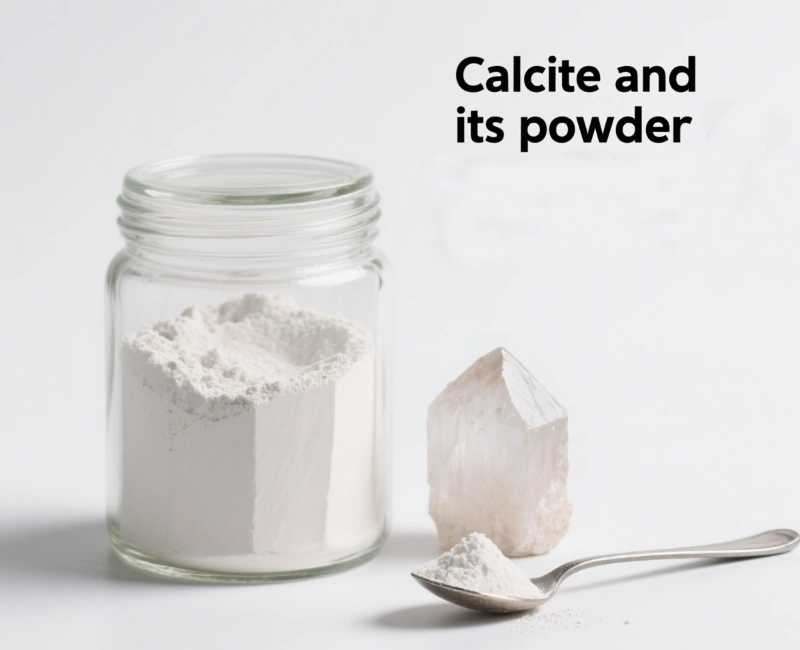
The ball mill–classifier system has demonstrated excellent performance in ultrafine calcite grinding and has become the preferred option for large GCC production lines with annual capacities of 50,000 to over 200,000 tons. Its main advantages include:
1. High Capacity and Scalability
Ball mills offer strong single-unit processing capacity. One large ball mill combined with multiple classifiers can achieve hourly outputs of several tens of tons, far exceeding those of jet mills or stirred mills. Industrial practice shows that this system is well suited for production lines exceeding 100,000 tons per year, with a short return on investment.
2. Precise Particle Size Control and Narrow Distribution
High-precision air classifiers provide accurate cut-point control (D97 adjustable), effectively preventing overgrinding. The resulting products exhibit narrow particle size distribution and uniform specific surface area, improving downstream performance such as dispersion and mechanical strength in plastic filling applications.
3. Energy Efficiency and Cost Advantages
Compared with a standalone ball mill, overall energy consumption is reduced by 20–30%. Compared with jet mills, energy consumption is significantly lower, as jet mills rely on high-pressure gas and compressed air systems. The low unit production cost makes this process ideal for large-scale continuous operation.
4. Stable Operation and Easy Maintenance
The system operates in a closed-loop, negative-pressure mode, preventing dust leakage. With a high level of automation, product quality remains stable. Compared with vertical mills or stirred mills, maintenance frequency is lower, and liners and grinding media have longer service life.
5. High Operational Flexibility
By adjusting classifier rotor speed, multiple product grades can be produced. Grinding aids can also be added to further improve grinding efficiency.
Internationally recognized suppliers such as EPIC Powder provide mature ball mill–classifier production lines, which are widely used in calcium carbonate processing, including calcite and marble.
Process Limitations: Not a Perfect Solution
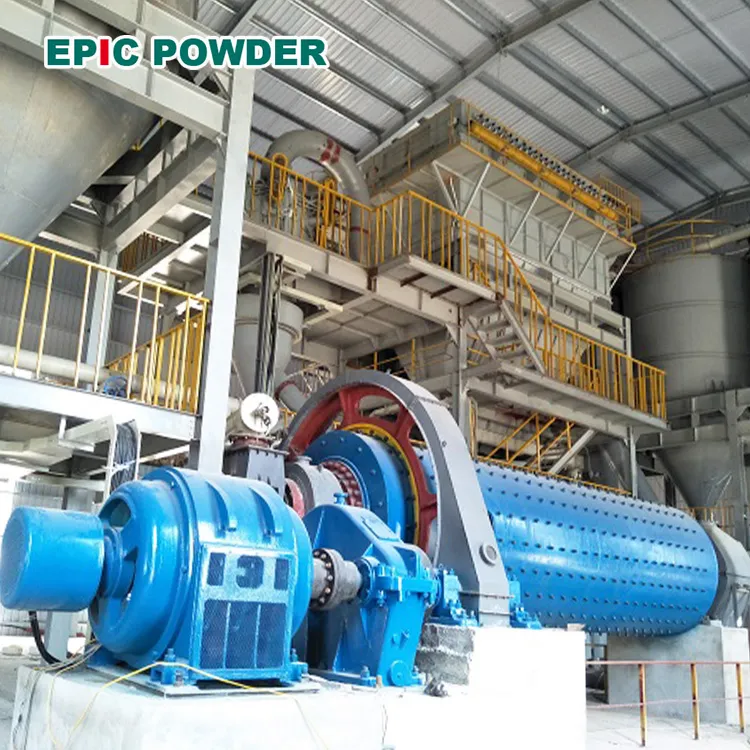
Despite its many advantages, the ball mill–classifier system is not suitable for all applications:
1. Relatively High Energy Consumption
Although more efficient than traditional ball milling, its overall power consumption is still higher than that of new-generation vertical mills, which can reduce specific energy consumption by up to 40%. In addition, grinding media wear may introduce iron contamination, requiring special liners.
2. Fineness Limitations
The system is best suited for particle sizes in the 5–45 μm range. Its efficiency drops significantly for ultrafine or near-nano sizes (<2 μm), where jet mills or wet stirred mills perform better.
3. Noise and Footprint
Ball mills generate relatively high noise levels and require sound insulation measures. The system consists of multiple pieces of equipment, resulting in a relatively large installation footprint.
4. Comparison with Other Ultrafine Calcite Powder Grinding Technologies
- Versus vertical mills: Vertical mills integrate grinding and classification with lower energy consumption and better environmental performance, but generally produce a broader particle size distribution, making them more suitable for medium-fine powders.
- Versus jet mills: Jet mills offer contamination-free grinding and finer particle sizes, but suffer from low throughput and high energy consumption, limiting large-scale applications.
- Versus stirred mills: Stirred mills excel in wet ultrafine grinding, but have limited capacity in dry processing.
Conclusion: One of the Optimal Solutions for Large-Scale Industrial Ultrafine Calcite Grinding
The combination of a ball mill and an air classifier ultrafine grinding is one of the optimal solutions for large-scale calcite production. It is particularly suitable for GCC lines with annual capacities above 50,000 tons. It performs best when fineness requirements are in the range of 1250–2500 mesh.
This process achieves a good balance between production capacity, operating cost, product quality, and system stability. It aligns well with industry trends toward high output, low energy consumption, and environmental compliance. Many large producers, such as those in the Hezhou GCC industrial base in Guangxi, have widely adopted this technology. Their experience demonstrates that the process is mature and reliable.
However, “optimal” is not an absolute concept. With ongoing technological development, new vertical mills or hybrid systems—such as roller presses combined with ball mills—may offer further improvements in energy efficiency and environmental performance. For ultrafine or high-purity products, jet milling or wet processing routes may be more appropriate. When selecting equipment, enterprises should consider raw material characteristics, product specifications, capacity targets, and investment budgets. A comprehensive evaluation is essential.
Looking ahead, the integration of intelligent control systems and high-efficiency classification technology will further enhance ball mill–classifier systems. They are expected to continue playing a leading role in large-scale calcite processing. For specific production requirements, consulting professional equipment suppliers for customized solutions is strongly recommended.

“Thanks for reading. I hope my article helps. Please leave a comment down below. You may also contact Zelda online customer representative for any further inquiries.”
— Posted by Emily Chen
 English
  العربية
  Español
  Português
  Français
  Türkçe
  Tiếng Việt
  Русский