
In the world of industrial powder processing—whether for lithium battery materials, high-purity quartz, or calcium carbonate—the “fineness” of a product is only half the story. The true mark of quality lies in the Particle Size Distribution (PSD). A narrow, precise PSD ensures consistent chemical reactivity, better flowability, and superior performance in end-use applications. When engineers design grinding circuits, they face a fundamental choice: Open-Circuit or Closed-Circuit. Open-circuit systems are simpler. However, the global industry has decisively shifted toward Closed-Circuit Ball Mill systems. The primary reason is clear: unparalleled precision in particle size control. This article delves into the technical mechanics and fluid dynamics of this process. We will also explore the operational advantages that make it the gold standard for precision grinding.
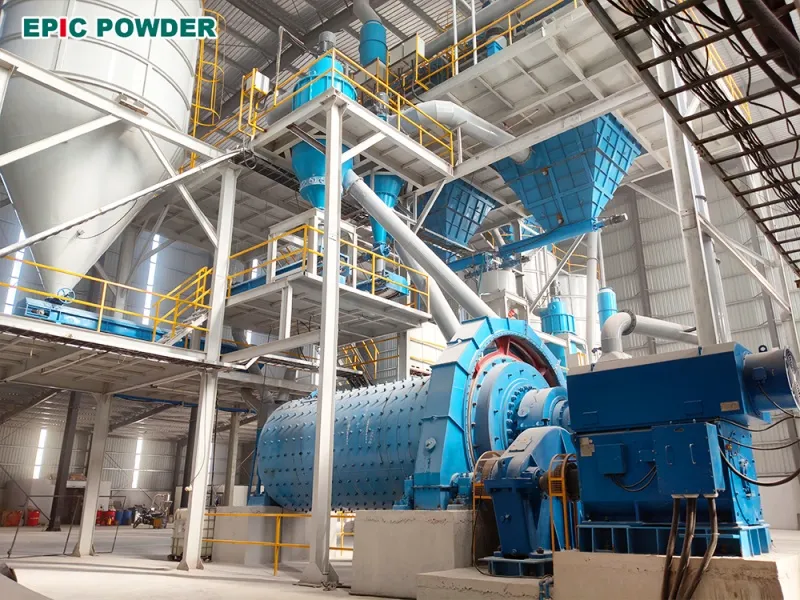
Understanding Ball Mill Grinding Basics
A ball mill is a cylindrical device filled with grinding media (usually steel or ceramic balls) that rotates to tumble and impact the feed material, reducing its particle size through attrition, impact, and compression. The efficiency of size reduction depends on factors like mill speed, ball size distribution, feed rate, and residence time.
In grinding processes, PSD refers to the range and proportion of particle sizes in the output material. A narrow, well-controlled PSD means most particles fall within a tight size range around the target (e.g., 80% passing a certain micron size, often denoted as P80). Wide distributions include excessive fines (over-grinding) or coarse particles (under-grinding), which can lead to inefficiencies.
Open-circuit grinding involves material passing through the ball mill only once, with no recirculation. The entire output becomes the final product. In contrast, closed-circuit grinding integrates a classifier (such as hydrocyclones, air separators, or screens) that separates the mill discharge into fine product and coarse oversize material. The oversize is returned to the mill for further grinding, creating a continuous loop.
This fundamental difference sets the stage for superior PSD control in closed circuits.
Defining the “Closed-Circuit” Advantage
To understand the precision, we must first define the mechanism. An open-circuit mill grinds material once and discharges it. In contrast, a closed-circuit system integrates a ball mill with a high-efficiency air classifier (or hydrocyclone for wet grinding).
The material exiting the mill is immediately sent to the classifier. The “fines” that meet the target specification are collected as the final product, while the “oversize” (coarse) particles are rejected and returned to the mill for further grinding.
2. The Prevention of Over-Grinding: The “Exit Strategy”
The most significant factor affecting PSD precision is over-grinding. In an open-circuit system, material must remain in the mill for an extended period. This is often necessary to ensure the “hardest” or largest particles reach the target fineness. Consequently, the “easier” particles are ground far beyond the required specification. This creates an excessive amount of unwanted “super-fines” or “dust.”
The Mechanism of Precision:
In a closed-circuit process, as soon as a particle reaches the desired size, it is “scouted” and removed by the classifier. By removing qualified particles quickly, the system avoids wasting energy on material that is already finished. This creates a narrower distribution curve, significantly reducing the volume of sub-micron particles that can often ruin the rheology of a slurry or the density of a powder compact.
The Role of the High-Efficiency Air Classifier
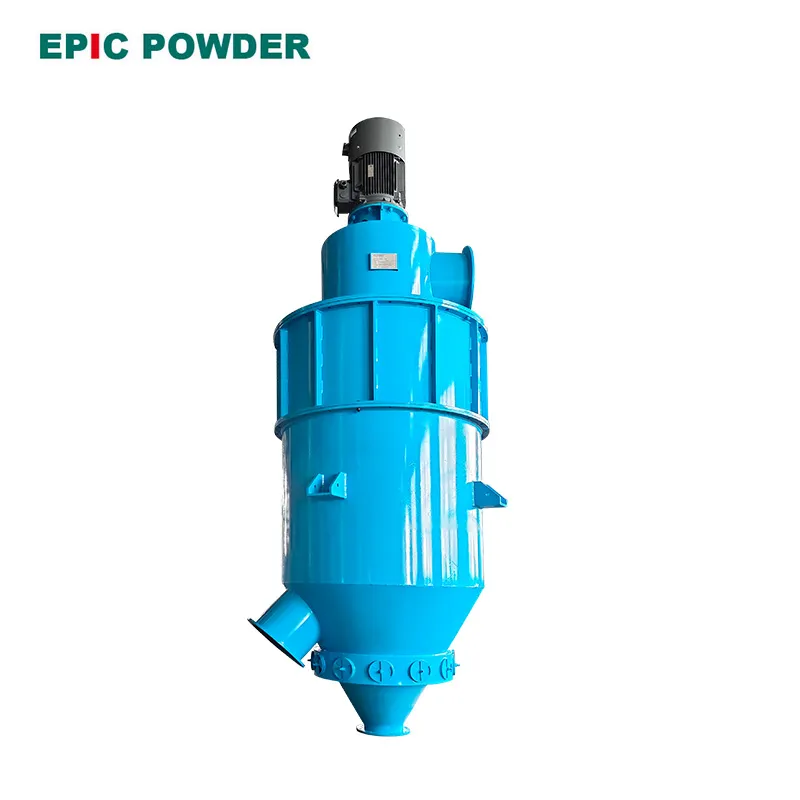
The precision of a closed-circuit system is actually a tribute to the synergy between the mill and the classifier. Modern air classifiers, such as those used in ultrafine powder processing, utilize a high-speed rotor to create a precise centrifugal field.
- Centrifugal Force vs. Drag Force: Within the classifier, particles are subjected to a balance of forces. Larger particles are thrown outward by centrifugal force (returned to the mill), while smaller particles are pulled inward by air drag (collected as product).
- Adjustability: Unlike a fixed mill screen, the rotor speed and airflow of a classifier can be adjusted in real-time. This allows operators to “tune” the cut-point (D97) with surgical precision, something impossible in a single-pass open-circuit setup.
Circulating Load: The Secret to Uniformity
A counter-intuitive aspect of the closed-circuit process is the Circulating Load—the mass of material returned to the mill. A high-performing system often operates with a circulating load of 200% to 500%.
Why does returning material increase precision?
- Increased Material Velocity: High circulation means material travels through the mill faster. This reduces the residence time per pass, ensuring that no single particle is subjected to the grinding media for too long.
- Bed Stability: A consistent flow of return material stabilizes the “grinding bed” inside the mill. This constant volume prevents the “surges” in particle size often seen in batch or open-circuit continuous feeding.
- Selective Grinding: The mill effectively “sees” only the coarse particles. Since the fines are removed, the grinding energy is focused entirely on the particles that actually need it, leading to a much more uniform reduction across the entire batch.
Impact on Downstream Industrial Applications
The precision of a closed-circuit PSD has transformative effects on specific industries:
Lithium Battery Materials (Cathode/Anode):
For materials like LFP (Lithium Iron Phosphate) or Hard Carbon, a stray “large” particle can cause a battery short-circuit, while excessive “fines” lead to poor electrolyte wetting. The closed-circuit ball mill ensures a steep PSD curve, maximizing energy density and safety.
High-Purity Quartz:
In the semiconductor industry, quartz powder must meet strict D50 and D97 targets. Closed-circuit systems prevent the creation of ultra-fine silica dust, which is difficult to handle and can negatively affect the melting process in glass and crucible production.
Calcium Carbonate:
In paper and plastic fillers, a precise PSD determines the opacity and tensile strength of the final product. Closed-circuit grinding allows manufacturers to produce “engineered” grades of CaCO3 that command much higher market prices than standard fillers.
Industrial Applications and Case Insights
Closed-circuit ball mills dominate in cement finish grinding, where precise fineness controls setting time and strength. In mining, they prepare flotation feed with optimal liberation sizes, minimizing over-grinding of valuable minerals.
For example, fly ash processing benefits from air classifiers paired with ball mills, producing uniform pozzolanic materials for concrete. Similarly, in pigment or filler production, narrow distributions improve dispersion and performance.
Comparisons between grinding systems (e.g., rod-ball vs. autogenous in closed circuit) highlight that closed configurations generally yield flatter or more uniform frequency curves, favorable for processes like pelletization.
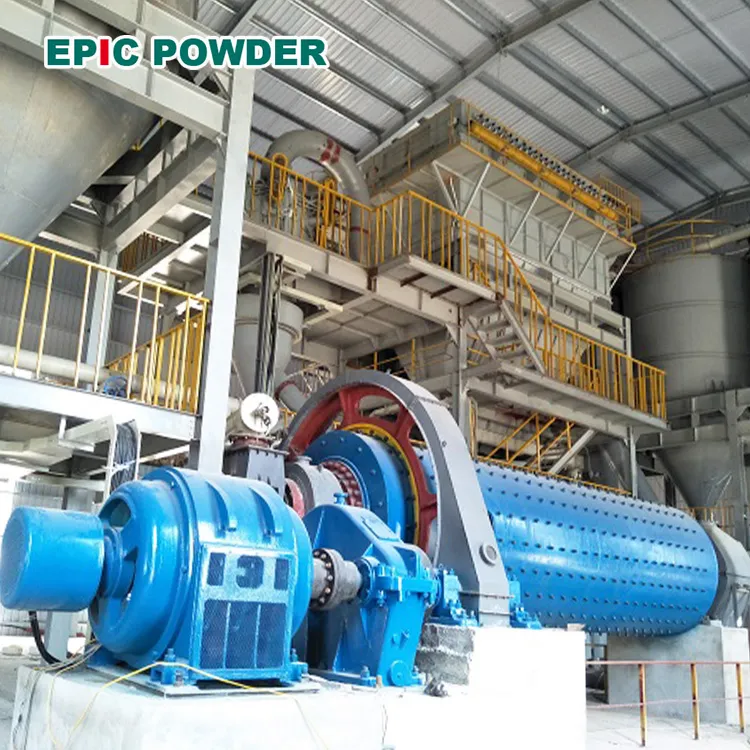
Energy Efficiency and Economic Impact
Precision isn’t just about quality; it’s about the bottom line. Over-grinding is essentially the “heat of friction” that does no useful work.
- Energy Savings: Closed-circuit systems can reduce specific energy consumption (kWh/t) by 15% to 30% because they stop grinding as soon as the target is met.
- Increased Capacity: Because the mill is not clogged with “dead-weight” fines, the total throughput of the circuit can be significantly higher than an open-circuit mill of the same size.
Conclusion
Precision in a closed-circuit ball mill process stems from a perfectly balanced feedback loop. The system integrates high-speed classification with rapid material transit. By doing so, it eliminates the “tail” of the distribution curve at both ends. This prevents both unwanted coarse grit and excessive fine dust.
For modern manufacturers, the choice is clear. If your application demands consistency and efficiency, the closed-circuit system is a technical necessity. It is the key to creating high-value end products. As we look toward 2026, classifier automation and grinding media technology will continue to refine. These advancements will only widen the precision gap between closed-loop systems and traditional methods.

“Thanks for reading. I hope my article helps. Please leave a comment down below. You may also contact Zelda online customer representative for any further inquiries.”
— Posted by Emily Chen
 English
  العربية
  Español
  Português
  Français
  Türkçe
  Tiếng Việt
  Русский